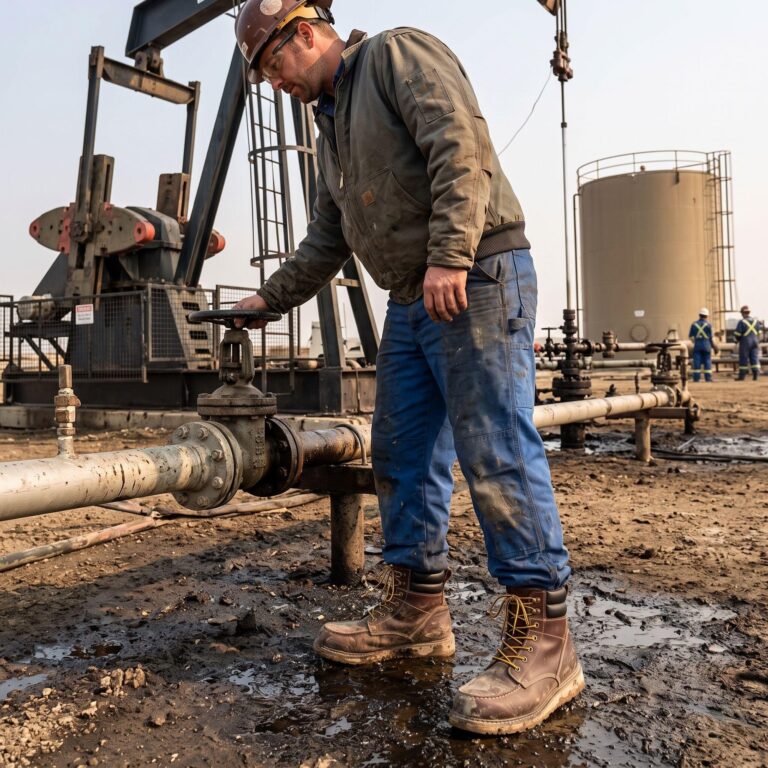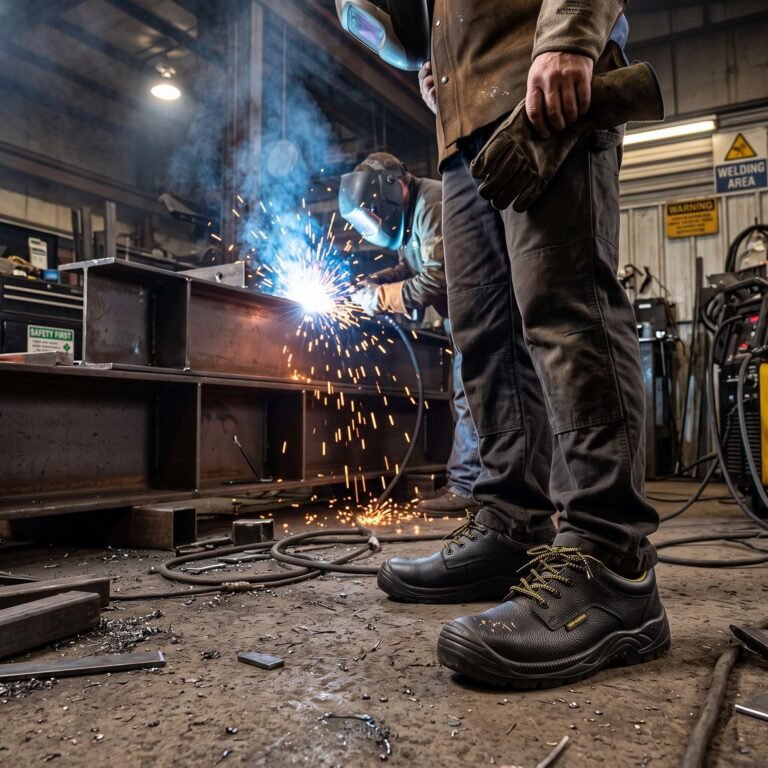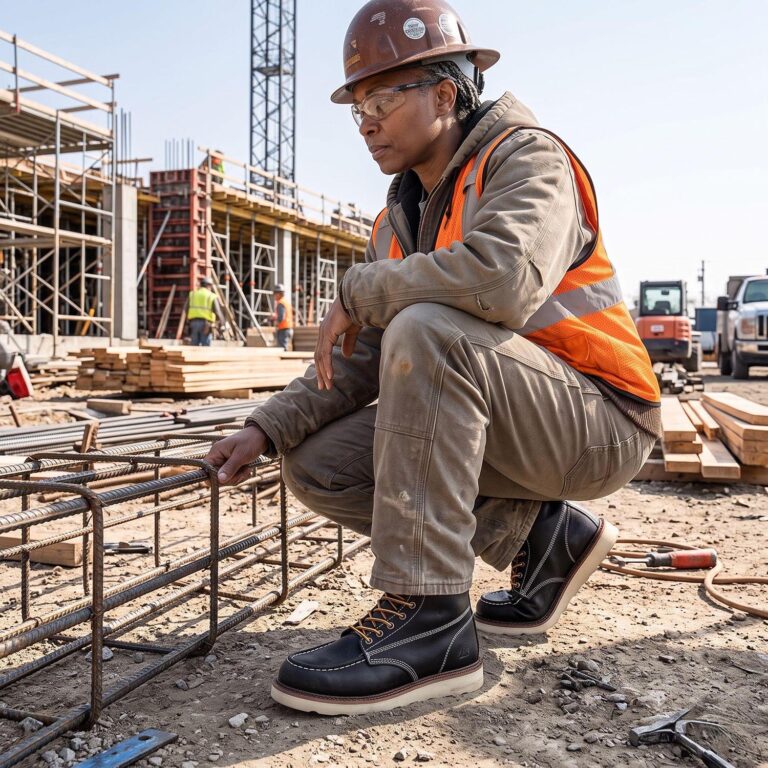

Steel toe caps protect workers’ toes from falling objects, heavy materials, and accidental impacts. However, not every workplace has the same hazards. Understanding how steel toe safety shoes work helps buyers choose suitable footwear for specific working conditions.
What Is the Purpose of a Steel Toe Cap in Safety Shoes?
A steel toe cap is a protective component built into the front of a safety shoe. It covers the toe area and helps reduce the risk of crush injuries when heavy objects fall onto the foot or collide with it.
In industrial workplaces, workers may handle metal components, construction materials, machinery parts, or warehouse goods. A dropped object can cause fractures, bruising, or other serious foot injuries. Steel toe caps provide a protective barrier between these external forces and the toes.
Unlike ordinary work shoes, steel toe safety shoes are designed and tested to meet specific impact and compression requirements. The protective cap is positioned inside the shoe, usually beneath the upper material, so it does not interfere significantly with the shoe’s external appearance.
Common applications include:
- Construction sites: Protection against falling tools, bricks, and building materials.
- Manufacturing facilities: Reduced risk of toe injuries caused by metal parts, equipment, and heavy components.
- Warehouses and logistics: Protection when moving cartons, pallets, and packaged goods.
- Automotive workshops: Additional protection when handling mechanical components and tools.
- Mining and heavy industry: Foot protection against heavy materials and certain workplace impact hazards.
The main purpose of a steel toe cap is to reduce the likelihood and severity of toe injuries. However, it does not eliminate every foot injury risk, and its effectiveness depends on the shoe’s certified performance and the hazards present at work.
How Do Steel Toe Caps Protect Workers?
Steel toe caps work by resisting impact and compression forces. Their protective performance depends on the material, shape, thickness, manufacturing process, and applicable testing requirements.
1. Protection Against Falling Objects
When an object falls onto the front of a shoe, the toe cap helps prevent the external force from directly crushing the toes.
For example, a metal component dropped during assembly work may cause severe injury if a worker wears ordinary footwear. A properly tested steel toe safety shoe can provide a stronger protective structure around the toes.
The degree of protection depends on the impact energy, the object’s shape, and whether the footwear meets the relevant safety standard.
2. Resistance to Compression
Compression injuries can occur when a heavy object presses against the front of the foot. This may happen when materials shift, equipment moves, or a worker’s foot becomes trapped between objects.
A steel toe cap is designed to resist a specified compressive load under standardized test conditions. This helps protect the toe area when the shoe experiences pressure from external objects.
However, a toe cap is not designed to protect the entire foot from every crushing hazard. Heavy loads may still injure the midfoot, ankle, or other areas outside the cap’s coverage.
3. A Durable Protective Structure
Steel has high strength and stiffness, making it suitable for manufacturing protective toe caps. When properly designed and integrated into the footwear, it can provide reliable resistance to impact and compression while maintaining a relatively compact shape.
Steel toe caps are widely used in industrial safety footwear because they combine established protective performance with mature manufacturing processes.
The finished shoe still requires appropriate testing. The presence of a steel cap alone does not prove that the entire shoe complies with a particular safety standard.
Steel Toe Caps and Safety Shoe Standards
When purchasing steel toe safety shoes, buyers should check the applicable standard rather than relying only on product descriptions.
EN ISO 20345:2022
EN ISO 20345:2022 is a European standard for safety footwear. It establishes requirements for protective toe caps and other relevant footwear properties.
Under the standard, safety footwear generally includes a protective toe cap designed to withstand an impact energy of 200 joules and a compression force of 15 kilonewtons under the specified test methods.
These figures describe standardized laboratory test conditions. They should not be interpreted as a guarantee that the shoe will prevent injury under every real-world accident scenario.
The standard also addresses other protective properties, depending on the footwear classification and the additional features claimed by the manufacturer. These may include slip resistance, resistance to fuel oil, water penetration, puncture resistance, and other requirements.
Buyers should confirm the exact classification and additional markings required for their applications. Not every safety shoe provides every protective feature.
ASTM F2413
ASTM F2413 is a US standard covering performance requirements for protective footwear. It includes requirements related to impact and compression protection, with additional classifications or markings addressing other hazards where applicable.
For buyers supplying the US market, it is important to verify that the footwear has been tested and marked in accordance with the relevant requirements. European and US standards should not be treated as automatically interchangeable.
A supplier should be able to provide applicable test reports, certification or conformity documentation where required, and product markings that match the footwear being supplied.
Steel Toe vs. Composite Toe: Which Is Better?
Steel toe caps are not the only option for protective footwear. Composite toe caps, typically made from non-metallic materials, are another common choice.
| Feature | Steel Toe Cap | Composite Toe Cap |
|---|---|---|
| Protective function | Designed to meet specified impact and compression requirements | Can provide equivalent protection when tested to the same applicable requirements |
| Material | Steel | Non-metallic materials |
| Weight | Often heavier than comparable composite designs | Often lighter, depending on construction |
| Metal detection | May trigger metal detectors | Generally does not contain metal in the toe cap |
| Electrical considerations | Conductive metal requires careful hazard assessment | The toe cap itself is non-metallic, but the whole shoe must be assessed |
| Common applications | Manufacturing, construction, warehousing, and heavy-duty work | Security-sensitive workplaces, electrical-related applications, and general industrial use where suitable |
Neither option is automatically better for every workplace.
Steel toe caps may suit buyers looking for a well-established protective construction with durable metal components. Composite toe caps may be preferable where lower weight or avoiding metal detection is important.
However, electrical protection should never be assumed solely because a toe cap is composite. The shoe’s complete construction, applicable certification, and workplace conditions must be considered.
What Should Buyers Check Before Choosing Steel Toe Safety Shoes?
Selecting the correct footwear involves more than choosing steel toe protection. Buyers should evaluate the following factors.
Workplace hazards: Identify whether workers face falling objects, compression, sharp materials, slippery floors, chemicals, heat, or electrical hazards. Each hazard may require a different combination of protective features.
Safety classification: Check the relevant standard and product markings. For European applications, confirm the applicable EN ISO 20345 requirements and the footwear’s declared classification. For US applications, verify the relevant ASTM requirements.
Fit and comfort: Toe caps must provide sufficient space for the toes without creating excessive pressure. Poor fit can cause discomfort and affect workers’ willingness to wear protective footwear throughout the shift.
Outsole performance: Workers in oily, wet, or uneven environments may need specific outsole properties. A protective toe cap does not automatically provide adequate slip resistance or puncture protection.
Construction quality: Examine how the toe cap is integrated into the upper, the consistency of stitching or bonding, outsole attachment, and overall workmanship. These factors contribute to footwear durability and service life.
Documentation and traceability: Confirm that product labels, test reports, and conformity documents correspond to the supplied model. For bulk orders, buyers should also verify sizes, specifications, packaging, and quality-control procedures.
Common Misunderstandings About Steel Toe Safety Shoes
One common misconception is that all steel toe shoes provide the same level of protection. In reality, performance depends on the applicable standard, test results, product design, and manufacturing quality.
Another misunderstanding is that steel toe caps make footwear indestructible. They are designed to resist specified impact and compression forces, not unlimited loads. Severe accidents can still cause injuries even when workers wear compliant safety footwear.
Some buyers also assume that steel toe shoes are always uncomfortable or excessively heavy. Comfort depends on the overall shoe design, materials, fit, outsole, and intended application. Comparing complete footwear models is more useful than judging them by toe cap material alone.
Finally, steel toe protection should not replace workplace safety procedures. Proper material handling, equipment maintenance, housekeeping, and hazard controls remain necessary to reduce the risk of foot injuries.
Why Do Safety Shoes Have Steel Toe Caps?
Safety shoes have steel toe caps to help protect workers against toe injuries caused by falling objects, impact, and compression. The cap creates a reinforced protective area at the front of the footwear and is designed to meet specified performance requirements under applicable safety standards.
Steel toe safety shoes are commonly used in construction, manufacturing, warehousing, automotive workshops, and other environments where workers may encounter heavy materials or impact hazards. When selecting footwear, buyers should consider the workplace risks, applicable standards, fit, outsole properties, and product documentation.
The right choice is not simply a shoe with a steel cap. It is a complete safety shoe that has been appropriately tested and selected for the conditions in which it will be used.
Written by Hong Gu Safety Shoes Technical Team, this content is compiled from practical production, long-term field applications, and rigorous testing results.
Shan Dong Hong Gu Shoes Industrial Co., Ltd. is a leading safety footwear manufacturer based in China, specializing in industrial foot protection with over 20 years of manufacturing expertise.
Products are fully certified under European standards (CE EN ISO 20345:2022), offering a full range of manufacturing processes including PU/PU Injection, PU/Rubber, Goodyear Welted, and Rubber Cemented constructions.