
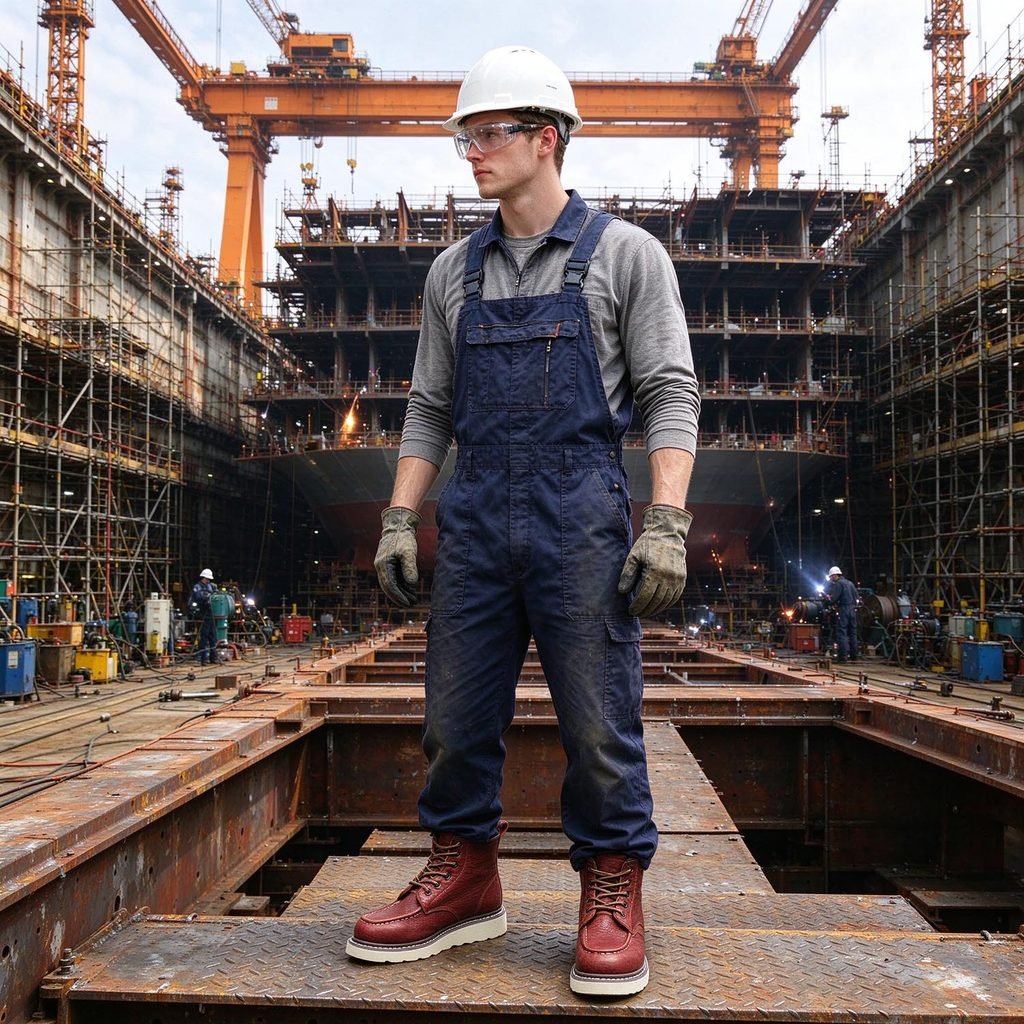
Safety shoe sole hardness directly affects walking comfort, slip resistance, wear performance, and stability. Choosing the wrong hardness can cause foot fatigue, poor ground contact, or premature sole damage in demanding workplaces.
What Is Sole Hardness in Safety Shoes?
Sole hardness refers to the resistance of a shoe sole material to indentation or deformation when force is applied. It is an important physical property used to evaluate the performance of safety footwear.
In safety shoe manufacturing, sole hardness is commonly measured using a Shore hardness tester. Different testing scales are used depending on the material. Shore A is commonly applied to softer materials such as polyurethane (PU) and rubber, while Shore D is more suitable for harder materials.
The hardness of a safety shoe sole is influenced by several factors:
- Material composition: Different PU formulations and rubber compounds produce different hardness levels.
- Density: The density and internal structure of the material affect its deformation characteristics.
- Manufacturing process: Injection molding, vulcanization, and curing conditions can influence the final hardness.
- Sole construction: Single-density and dual-density soles have different performance characteristics.
Sole hardness is not simply a measurement of whether a shoe feels hard or soft. It helps manufacturers understand how the outsole and midsole respond to pressure, repeated movement, and contact with different working surfaces.
How Does Sole Hardness Affect Safety Shoe Performance?
The hardness of a safety shoe sole influences several aspects of daily use. A suitable balance is necessary because workplace conditions vary considerably.
1. Walking Comfort and Foot Fatigue
A softer sole generally provides greater deformation under pressure. This can improve cushioning and help absorb some of the impact generated during walking.
For workers who stand for long periods or walk continuously, cushioning is an important consideration.
However, an excessively soft sole may compress too much under body weight. This can reduce stability and cause the shoe to feel less supportive.
A harder sole offers greater resistance to deformation. It may provide better support in certain applications, but excessive hardness can make walking uncomfortable, particularly on concrete or other rigid surfaces.
Manufacturers must balance cushioning, support, and material resilience when developing safety shoe soles.
2. Abrasion Resistance and Service Life
Sole hardness is also related to wear performance.
A properly formulated harder rubber compound may provide good resistance to abrasion in demanding working environments. This is useful in factories, warehouses, and construction sites where workers frequently walk across rough surfaces.
However, hardness alone cannot determine abrasion resistance.
A very hard sole is not automatically more durable. Material composition, tear strength, bonding performance, and resistance to repeated flexing also affect service life.
For example, a safety shoe used on rough concrete floors requires a different balance of properties from one used in an environment with smooth indoor flooring.
Manufacturers should evaluate sole hardness together with abrasion and flexing test results.
3. Slip Resistance and Ground Contact
Slip resistance is another important consideration in safety footwear.
The sole needs to maintain sufficient contact with the ground to provide friction during walking. Sole hardness can influence how the material deforms when it comes into contact with different surfaces.
A softer rubber compound may adapt more easily to small surface irregularities. However, this does not automatically mean it provides better slip resistance.
The actual result depends on:
- Rubber or PU compound formulation.
- Outsole tread pattern and groove depth.
- Contact area between the sole and floor.
- Floor material and surface contamination.
- Presence of water, oil, or other substances.
Slip resistance must be evaluated through appropriate testing rather than estimated from hardness measurements.
4. Stability and Load Support
Workers in manufacturing, logistics, and construction often carry heavy materials or equipment.
In these situations, sole deformation can affect walking stability.
A sole that is too soft may compress excessively under repeated loading. This can reduce support and make the footwear feel unstable.
A suitably firm sole helps maintain structural support while allowing enough flexibility for natural foot movement.
The design should also consider the midsole structure, outsole thickness, heel geometry, and overall shoe construction.
How Is Safety Shoe Sole Hardness Tested?
Shore hardness testing is widely used to evaluate the hardness of polymer-based materials.
The test uses an instrument called a durometer. A calibrated indenter presses against the material surface under a specified force. The instrument measures the material’s resistance to indentation and provides a hardness value.
The two commonly used scales include:
Shore A: Generally used for softer elastomers, flexible rubber, and many PU sole materials.
Shore D: Generally used for harder plastics and rigid polymer materials.
The selection of the testing scale depends on the material being evaluated.
For reliable results, manufacturers need to control several testing conditions:
- Sample preparation: The test specimen should have suitable thickness and a flat testing surface.
- Temperature control: Material hardness can change with temperature, so testing conditions should be consistent.
- Testing position: Measurements should avoid damaged areas, edges, and uneven surfaces.
- Measurement consistency: Multiple measurements may be necessary to understand variations across a sample.
- Instrument calibration: The durometer should be properly calibrated and maintained.
ASTM D2240 is a commonly referenced standard for measuring rubber and plastic hardness using a durometer. ISO 868 also specifies methods for determining indentation hardness using a durometer.
These standards help establish consistent testing procedures. They do not establish one universal hardness requirement for every safety shoe sole.
How to Choose the Right Sole Hardness for Different Work Environments
There is no single ideal hardness value for all safety footwear. The selection should reflect the working environment, expected loading, and required footwear performance.
Manufacturing and Warehouse Work
Workers in warehouses and manufacturing facilities may spend most of their shifts standing or walking on concrete floors.
A moderately firm sole with suitable cushioning can help balance support and comfort.
PU and dual-density PU constructions are commonly used in these applications because they allow manufacturers to combine different material properties within one sole structure.
Construction Sites
Construction workers frequently encounter gravel, uneven ground, concrete, and rough surfaces.
The sole needs sufficient structural strength, abrasion resistance, and resistance to mechanical damage.
Rubber outsoles or PU/Rubber constructions may be considered depending on the application. The hardness should be selected alongside the outsole tread design and material durability.
Oil and Chemical-Related Workplaces
In workshops, petrochemical facilities, and industrial processing environments, footwear may come into contact with oil, cleaning agents, or other substances.
In these conditions, chemical compatibility is particularly important.
The sole material must be selected according to the specific chemicals and exposure conditions. A high hardness value does not automatically indicate chemical resistance.
Manufacturers should evaluate relevant material resistance and footwear performance requirements before selecting the sole compound.
Long-Hour Standing Applications
Workers in assembly lines and production facilities may remain on their feet for extended periods.
A sole that is excessively hard can contribute to discomfort on rigid floors. A well-designed cushioning structure can help improve walking comfort.
However, softness should not compromise stability, support, or durability.
Common Misunderstandings About Safety Shoe Sole Hardness
When selecting safety footwear, several assumptions about sole hardness can lead to incorrect purchasing decisions.
Misunderstanding 1: Harder soles always last longer.
Not necessarily. Abrasion resistance depends on material formulation, tear strength, and manufacturing quality. A harder material may still crack or wear prematurely if its formulation is unsuitable.
Misunderstanding 2: Softer soles always provide better comfort.
A soft sole may feel comfortable initially, but excessive compression can reduce stability and support. Cushioning and structural performance need to work together.
Misunderstanding 3: Sole hardness determines slip resistance.
Slip resistance is influenced by the outsole compound, tread design, contact conditions, and floor contamination. Hardness testing cannot replace slip resistance testing.
Misunderstanding 4: All parts of a safety shoe sole should have the same hardness.
Not always. Dual-density sole constructions use different material properties in different areas. A softer midsole can provide cushioning, while a firmer outsole can improve structural support and wear performance.
Misunderstanding 5: One hardness specification applies to every workplace.
Different industries have different requirements. Manufacturers should select sole materials according to actual working conditions rather than using one fixed hardness value for every product.
What Should Buyers Check When Evaluating Safety Shoe Sole Hardness?
For importers, distributors, and industrial safety footwear buyers, checking a hardness value is only one part of product evaluation.
Before placing a bulk order, consider the following factors:
- Hardness test report: Confirm the Shore scale, measured value, testing method, and test conditions.
- Abrasion resistance: Check whether the sole material can withstand the expected level of surface wear.
- Flexing performance: Evaluate whether repeated bending causes cracks or structural damage.
- Slip resistance: Review test results relevant to the intended workplace.
- Bonding strength: For multi-layer soles, check the adhesion between different material layers and the upper.
- Temperature resistance: Consider the temperature range in which the footwear will be used.
- Chemical compatibility: Verify whether the material is suitable for exposure to specific industrial substances.
For safety footwear manufactured under EN ISO 20345:2022, the applicable performance requirements should be evaluated according to the relevant footwear category and intended application.
Sole hardness is a material property, not an independent certification of safety performance. A compliant safety shoe must meet the applicable requirements for its intended protective classification.
Why Is Sole Hardness Important in Safety Shoe Manufacturing?
Sole hardness is an important parameter in the development and quality control of safety footwear. It affects how materials respond to pressure, repeated movement, and contact with workplace surfaces.
For manufacturers, selecting the correct hardness involves balancing several properties rather than pursuing the highest possible value.
A well-developed sole should provide appropriate cushioning, sufficient support, reliable wear performance, and suitable flexibility for its intended working environment.
For buyers, comparing hardness test results alongside abrasion resistance, flexing performance, slip resistance, and bonding strength provides a more complete understanding of product quality.
The right sole hardness is therefore not simply about choosing a harder or softer material. It is about matching the material formulation and sole construction to the actual demands of the workplace.
Written by Hong Gu Safety Shoes Technical Team, this content is compiled from practical production, long-term field applications, and rigorous testing results.
Shan Dong Hong Gu Shoes Industrial Co., Ltd. is a leading safety footwear manufacturer based in China, specializing in industrial foot protection with over 20 years of manufacturing expertise.
Products are fully certified under European standards (CE EN ISO 20345:2022), offering a full range of manufacturing processes including PU/PU Injection, PU/Rubber, Goodyear Welted, and Rubber Cemented constructions.