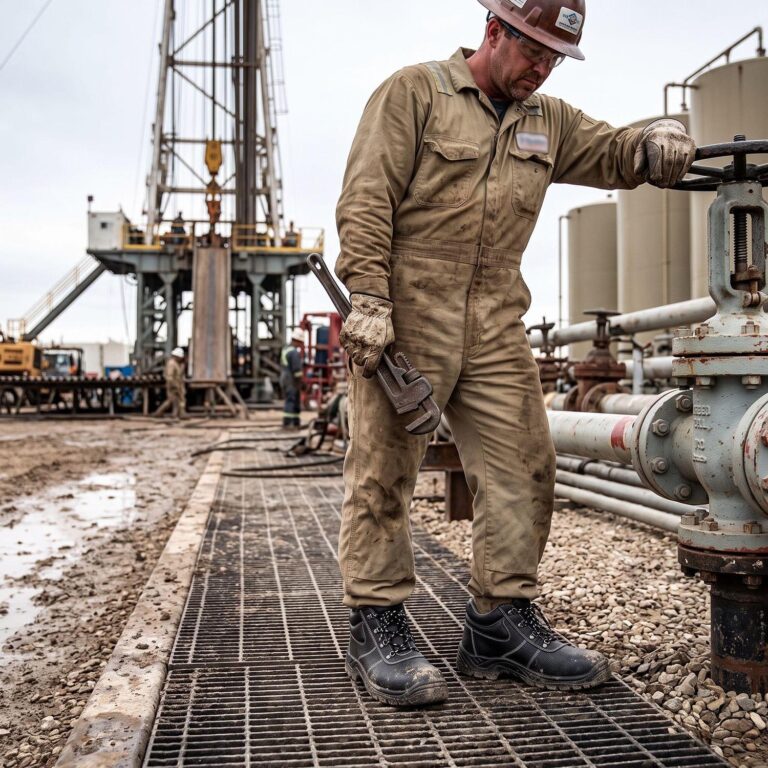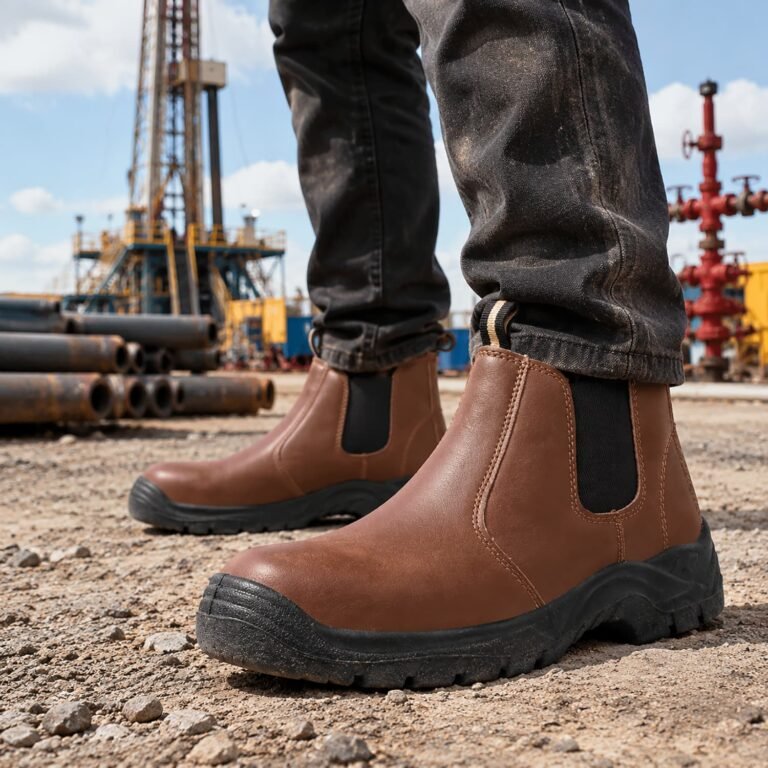

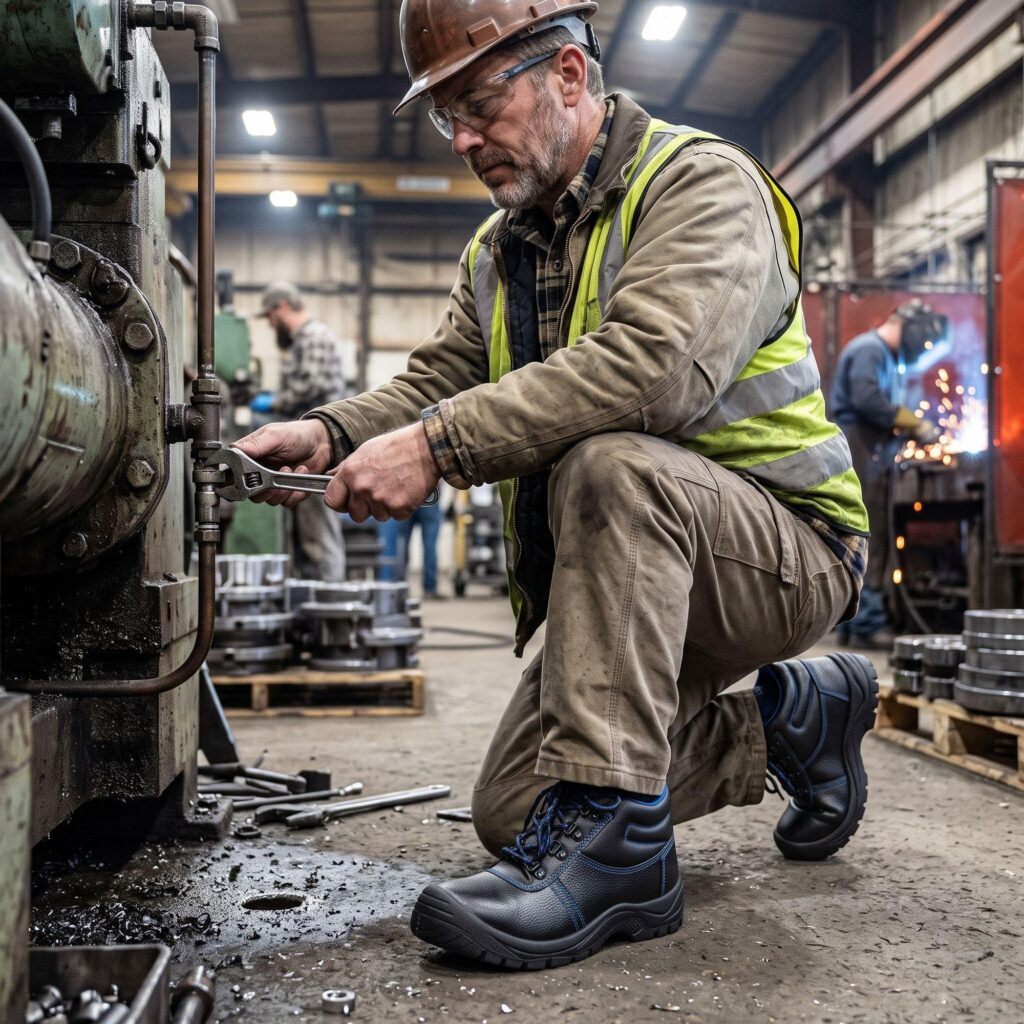
Chemical exposure can damage ordinary work shoes quickly. Workers in chemical plants, laboratories, cleaning facilities, and manufacturing sites need more than basic safety footwear. They need shoes that can resist chemical damage while also providing toe protection, slip resistance, comfort, and long-term durability.
Why Chemical Resistance Matters in Safety Footwear
Chemical-resistant safety shoes help protect footwear from contact with acids, alkalis, oils, solvents, cleaning agents, and other industrial chemicals.
However, chemical resistance does not depend on one material alone. The upper, outsole, stitching, adhesives, and other shoe parts all affect performance.
For example, a shoe may have a strong safety toe cap but still fail in a chemical environment. The outsole may swell. The upper may crack. The adhesive may lose strength. As a result, the shoe may no longer provide reliable protection.
Common signs of chemical damage include:
- Outsole swelling or softening
- Upper cracking or hardening
- Sole separation
- Loss of grip
- Changes in material strength
- Chemical penetration through seams or openings
Therefore, buyers should check the complete shoe instead of looking at the outsole alone.
Materials Used in Chemical Resistant Safety Shoes
Manufacturers use different materials for different work conditions. Each material has its own strengths.
| Material / Construction | Main Features | Typical Applications |
|---|---|---|
| PU | Lightweight, flexible, and resistant to many oils and industrial chemicals | Manufacturing and general industry |
| Rubber | Strong chemical and abrasion resistance | Chemical plants and heavy industry |
| Nitrile rubber | Good oil, abrasion, and heat resistance | Workshops and industrial production |
| PVC | Good resistance to many acids, alkalis, and chemicals | Wet work and industrial cleaning |
| Full polymer construction | Low water absorption and easy to clean | Wet and wash-down environments |
| PU/Rubber | Combines light weight with strong outsole performance | Industrial safety footwear |
Still, material selection needs care. A material that works well with one chemical may not work well with another.
The chemical type matters. So do the concentration, temperature, contact time, and exposure method.
For example, a material may handle a diluted chemical solution but perform poorly against a concentrated solution. Therefore, buyers should match the material to the real working environment.
How Manufacturing Technology Affects Chemical Resistance
Material choice is only one part of the process. Shoe construction also affects chemical resistance, durability, and bonding strength.
PU/PU Injection Construction
PU/PU injection uses polyurethane to form the sole structure. The process creates a close bond between the sole layers.
As a result, this construction can provide good flexibility and comfort. It also works well for many general industrial applications.
PU footwear also offers relatively low weight. Therefore, it can help reduce foot fatigue during long shifts.
PU/Rubber Construction
PU/Rubber footwear combines two materials with different strengths.
The PU layer provides a lighter and more flexible structure. Meanwhile, the rubber outsole can improve resistance to abrasion, heat, oils, and selected chemicals.
This combination can work well when workers need both comfort and stronger outsole performance.
Rubber Cemented Construction
Rubber cemented footwear uses adhesive to connect the outsole and upper.
The rubber compound can provide good abrasion and chemical resistance. However, adhesive performance also matters.
Therefore, manufacturers need to select adhesives that match the materials and intended working conditions. Poor adhesive selection can lead to sole separation after repeated chemical exposure.
Goodyear Welted Construction
Goodyear welted footwear uses a welt to connect the upper, insole, and outsole.
This method provides strong mechanical construction and good durability. It can also support repair in some footwear designs.
However, construction type alone does not make a shoe chemical resistant. The upper material, outsole compound, adhesive, stitching, and other components still need to match the chemical environment.
Chemical Resistance and EN ISO 20345:2022
EN ISO 20345:2022 provides important requirements for safety footwear used in European markets. The standard covers areas such as toe protection and other safety properties.
However, CE marking or compliance with EN ISO 20345:2022 does not mean that every safety shoe can resist every chemical.
Chemical resistance requires a more specific assessment. Buyers should therefore check the relevant test requirements and technical documents for the intended application.
Depending on the workplace, buyers may also need to consider:
- Safety toe cap performance
- Slip resistance
- Fuel oil resistance
- Puncture resistance
- Antistatic properties
- Water resistance
- Heat resistance
- Outsole abrasion resistance
In addition, buyers should request test reports and technical data from the manufacturer. These documents can help confirm whether the footwear matches the working environment.
How to Choose Chemical Resistant Safety Shoes
A simple five-step process can make selection easier.
1. Identify the Chemical
First, list the exact chemicals used at the workplace.
Avoid general descriptions such as “industrial chemicals.” Different chemicals can affect the same material in very different ways.
2. Check Concentration and Temperature
Next, check the chemical concentration and working temperature.
Higher concentrations and temperatures can increase material damage. Therefore, the footwear should match the actual exposure conditions.
3. Check the Exposure Method
Consider how the chemical contacts the shoe.
For example, workers may face:
- Occasional splashes
- Repeated contact
- Wet floors
- Direct chemical spills
- Continuous immersion
Each situation creates different footwear requirements.
4. Check the Complete Shoe
Do not check the outsole alone.
Instead, review the upper, outsole, seams, stitching, adhesives, toe area, tongue, and other exposed components.
5. Check Test Documents
Finally, ask the manufacturer for technical specifications and relevant test reports.
Where possible, compare the test conditions with the actual workplace conditions. This approach gives buyers a clearer basis for selecting suitable safety footwear.
Common Mistakes When Choosing Chemical Resistant Safety Shoes
One common mistake is confusing waterproofing with chemical resistance.
Water-resistant footwear may prevent water from entering the shoe. However, that does not mean the material can resist acids, solvents, oils, or other chemicals.
Another mistake is focusing only on the outsole. Chemical exposure can also damage the upper, stitching, and adhesive layers.
In addition, avoid relying only on broad claims such as “acid resistant” or “chemical resistant.” Always check which chemicals the footwear can handle and under what conditions.
Temperature also matters. Chemical resistance can change when the temperature rises.
Finally, inspect footwear regularly. Repeated chemical exposure, abrasion, cleaning, and aging can reduce material performance over time. Replace footwear when you find cracks, swelling, sole separation, or other signs of damage.
What Makes a Safety Shoe Chemical Resistant?
Chemical-resistant safety shoes combine suitable materials, proper construction, and verified performance.
PU, rubber, nitrile rubber, and PVC can all serve different industrial needs. However, no single material provides the same level of resistance against every chemical.
Therefore, buyers should consider chemical type, concentration, temperature, exposure time, exposure method, material compatibility, shoe construction, and applicable safety standards.
EN ISO 20345:2022 provides important safety footwear requirements. However, buyers should not assume that CE marking alone proves resistance to a specific chemical.
The right approach is simple: identify the chemical, understand the exposure conditions, select compatible materials, check the complete shoe construction, and verify the relevant test data.
Written by Hong Gu Safety Shoes Technical Team, this content is compiled from practical production, long-term field applications, and rigorous testing results.
Shan Dong Hong Gu Shoes Industrial Co., Ltd. is a leading safety footwear manufacturer based in China, specializing in industrial foot protection with over 20 years of manufacturing expertise.
Products are fully certified under European standards (CE EN ISO 20345:2022), offering a full range of manufacturing processes including PU/PU Injection, PU/Rubber, Goodyear Welted, and Rubber Cemented constructions.