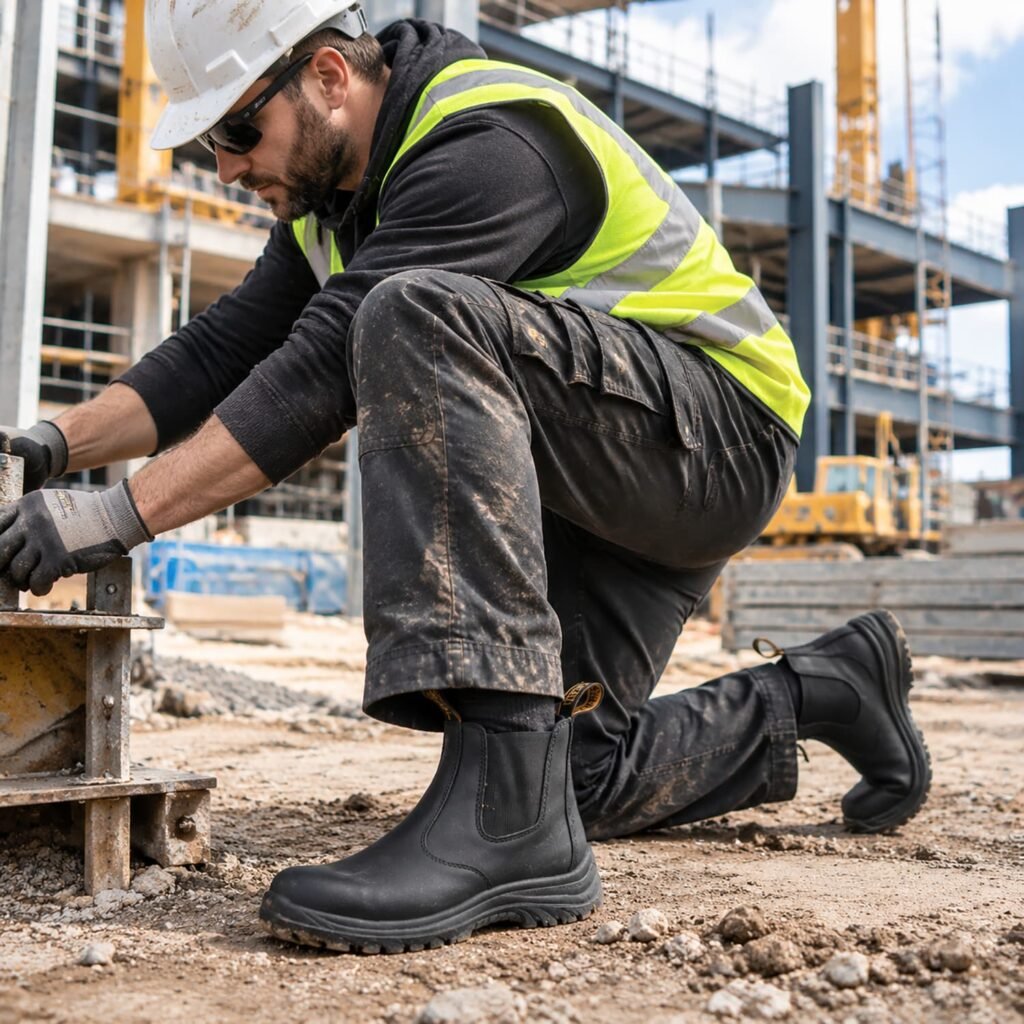
A Quality Management System in Safety Shoe Manufacturing helps manufacturers prevent production defects, maintain consistent product quality, and verify protective performance. Without effective quality controls, material variations, assembly errors, and inadequate testing can lead to failed inspections, customer complaints, and potential workplace hazards.
Why Quality Control Must Start Before Production
In safety shoe manufacturing, defects often begin long before the finished product reaches the inspection table. Variations in raw materials, incorrect component dimensions, unstable bonding conditions, or poorly controlled assembly procedures can affect the performance of the final footwear.
A quality management system (QMS) establishes documented procedures for controlling these risks. It connects supplier evaluation, material inspection, production monitoring, laboratory testing, and shipment approval into one coordinated process.
For manufacturers supplying construction sites, factories, warehouses, and other industrial workplaces, quality requirements extend beyond appearance. The footwear must meet the specifications for its intended protective functions while maintaining consistent dimensions, construction, and workmanship.
An effective QMS also creates traceable records. When a defect appears, quality personnel can investigate the affected production batch, review inspection results, and identify where the problem originated. This makes corrective action more practical than relying on repeated repairs or additional final inspections.
Which Production Stages Need the Closest Quality Control?
Raw Material Selection and Supplier Verification
The quality of finished safety footwear depends heavily on the consistency of its components. Upper materials, toe caps, insoles, outsole compounds, adhesives, and lining materials should all meet approved specifications.
Incoming inspection should focus on characteristics that can influence product performance. Depending on the material, these may include thickness, dimensions, hardness, flexibility, appearance, and identification.
Manufacturers should also maintain supplier evaluation records and define procedures for handling materials that fail inspection. Materials with uncertain identification or unacceptable test results should be isolated until their suitability has been established.
Supplier changes require particular attention. A replacement adhesive or a different outsole compound may affect bonding strength, flexibility, or durability, even when the finished footwear looks similar.
Component Preparation and Assembly
Different safety shoe manufacturing methods require different process controls. The quality management system should reflect the actual construction method instead of relying on a single inspection procedure for every product.
For PU/PU injection footwear, production controls may cover material preparation, injection parameters, mold conditions, component positioning, and curing. Incorrect settings can result in uneven soles, dimensional inconsistencies, or bonding defects.
PU/Rubber footwear requires attention to the compatibility and adhesion of the materials involved. Goodyear welted construction needs consistent welt attachment, stitching, and sole assembly. Rubber cemented footwear depends on appropriate surface preparation, adhesive application, bonding pressure, and curing time.
Each process should have defined operating instructions and acceptance criteria. Operators need to know which parameters require monitoring, how to identify abnormal conditions, and when production must be stopped for investigation.
In-Process Inspection
Waiting until the end of production to identify defects increases the risk of unnecessary rework and material waste. In-process inspections help identify problems while corrective action remains manageable.
Typical checkpoints include:
- Toe cap positioning and component alignment.
- Stitching quality and upper construction.
- Lasting accuracy and footwear dimensions.
- Sole attachment, bonding appearance, and heel alignment.
- Visible material defects and assembly inconsistencies.
Inspection results should be recorded by product model, production batch, or another appropriate identification method. When the same defect appears repeatedly, the production team can examine equipment settings, material batches, work instructions, and operator procedures.
The purpose is not simply to reject defective pairs. It is to identify recurring causes and prevent them from affecting subsequent production.
How Can Manufacturers Verify Safety Shoe Performance?
Visual inspection cannot establish whether safety footwear provides the required level of protection. Product testing must address the specific requirements associated with the footwear classification and intended use.
For safety footwear intended for European markets, EN ISO 20345:2022 establishes applicable requirements for protective footwear. Depending on the product and its intended claims, verification may cover toe protection, slip resistance, resistance to fuel or oil where applicable, water-related properties, and other specified characteristics.
Manufacturers should establish a testing plan based on the applicable standard, product design, materials, and market requirements.
Mechanical and physical testing helps evaluate characteristics such as toe cap protection, sole properties, and bonding performance where relevant. These tests provide measurable evidence rather than relying solely on visual judgments.
Material and component testing checks whether selected materials meet their defined requirements. Changes to material suppliers or component specifications may require additional evaluation before the revised product enters production.
Dimensional and workmanship checks verify that finished footwear matches the approved design. Size consistency, component placement, stitching, and sole alignment can affect fit, usability, and product quality.
Compliance documentation connects test results with the relevant product model and configuration. Manufacturers should retain applicable test reports, technical documentation, inspection records, and conformity assessment evidence.
Testing frequency should reflect the applicable requirements, product risks, customer specifications, and manufacturing changes. A test report for one model should not automatically be treated as evidence that every model meets the same requirements.
What Should an Effective Quality Management System Measure?
A QMS becomes more useful when manufacturers track measurable results instead of relying on paperwork alone.
Several indicators can help identify weaknesses in safety footwear production.
| Quality indicator | What it helps identify |
|---|---|
| Incoming material rejection rate | Supplier inconsistency and material defects |
| First-pass yield | The proportion of products passing inspection without rework |
| Production defect rate | Recurring problems in assembly and manufacturing |
| Bonding test results | Whether relevant sole attachment requirements are met |
| Customer complaint rate | Quality issues reported after delivery |
| Corrective action closure time | How efficiently identified problems are investigated and addressed |
These indicators should be reviewed alongside production records and inspection findings. For example, a rise in sole bonding failures may require an investigation into surface preparation, adhesive handling, curing conditions, or material compatibility.
Corrective action should address the cause rather than only the visible symptom. After a process change, follow-up inspections or testing should confirm whether the problem has been resolved.
ISO 9001 provides a framework for establishing, implementing, and continually improving a quality management system. It helps organizations define responsibilities, manage documented processes, evaluate performance, and address nonconformities. However, ISO 9001 certification alone does not establish that a particular safety shoe meets EN ISO 20345 or other product-specific requirements.
Common Quality Management Mistakes to Avoid
One frequent mistake is treating final inspection as the main quality safeguard. Some defects can be identified visually, but protective performance requires appropriate testing and verification.
Another mistake is applying identical acceptance criteria to different footwear constructions. Injection-molded, welted, and cemented footwear involve different manufacturing processes and failure risks. Their control plans should reflect those differences.
Incomplete traceability is another concern. If a customer reports a defect, manufacturers should be able to identify relevant production records and investigate the affected products. The level of traceability should match the product risks, contractual requirements, and applicable regulations.
Manufacturers should also review process changes before implementation. Adjustments to toe caps, sole compounds, adhesives, or product construction may affect conformity and should be evaluated before the revised footwear is approved for production.
Finally, a quality management system should remain practical for factory personnel. Clear work instructions, appropriate training, usable inspection forms, and timely corrective action are more effective than extensive documentation that does not influence daily production decisions.
How Can Buyers Evaluate a Safety Shoe Manufacturer’s Quality System?
Industrial buyers should look beyond general claims about quality. They can request relevant product specifications, inspection procedures, applicable test reports, and evidence that production controls match the footwear being purchased.
It is also useful to ask how the manufacturer handles failed inspections, monitors material suppliers, investigates recurring defects, and manages changes to approved product designs.
For orders requiring EN ISO 20345 compliance or other market-specific requirements, buyers should verify that the available documentation covers the exact product model and relevant configuration. Certification scope, test evidence, and conformity documentation should be checked rather than assumed.
A reliable quality management system connects these records with actual factory procedures. This allows buyers to assess how quality is controlled during production, not merely how the finished footwear looks before shipment.
What Makes a Quality Management System Effective in Safety Shoe Manufacturing?
An effective quality management system combines supplier control, incoming material inspection, construction-specific production procedures, in-process monitoring, appropriate performance testing, and documented corrective action. Together, these measures help manufacturers maintain consistent safety footwear quality and identify defects before shipment.
The system should be tailored to the product design, manufacturing method, intended workplace application, and applicable market requirements. ISO 9001 can support process management and continual improvement, while product-specific testing and conformity assessment establish whether safety footwear meets its required protective standards.
For manufacturers and industrial buyers, the most useful evidence is a clear connection between documented procedures, actual production controls, traceable inspection results, and verified product performance.
Written by Hong Gu Safety Shoes Technical Team, this content is compiled from practical production, long-term field applications, and rigorous testing results.
Shan Dong Hong Gu Shoes Industrial Co., Ltd. is a leading safety footwear manufacturer based in China, specializing in industrial foot protection with over 20 years of manufacturing expertise.
Products are fully certified under European standards (CE EN ISO 20345:2022), offering a full range of manufacturing processes including PU/PU Injection, PU/Rubber, Goodyear Welted, and Rubber Cemented constructions.