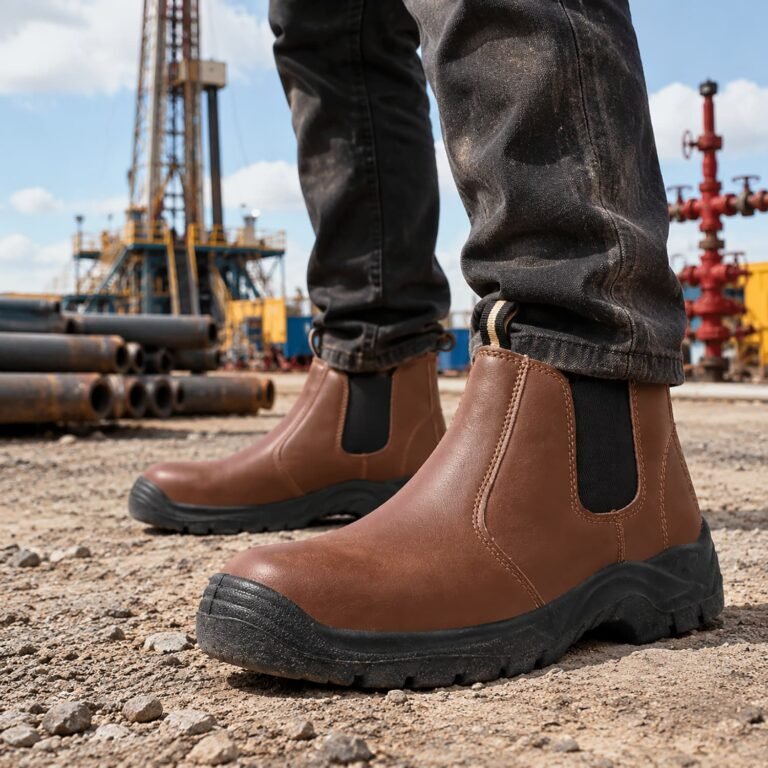


Sole bonding strength testing checks whether the outsole remains securely attached to the upper during use. For safety footwear, weak adhesion can cause sole separation, reduce durability, and affect worker protection in demanding environments. Proper Sole Bonding Strength Testing helps manufacturers identify bonding defects and maintain consistent footwear quality.
Why Sole Bonding Strength Matters in Safety Footwear
The bond between the sole and the upper is a critical part of safety footwear construction. Safety shoes may be exposed to repeated bending, abrasion, moisture, temperature changes, oils, and other workplace conditions. If the bond is inadequate, the outsole may begin to peel away from the upper, particularly around the toe, forefoot, or heel.
Sole bonding strength refers to the force required to separate the sole from the upper or to propagate separation along the bonded interface. It is commonly evaluated through a peel-type test, with the result expressed as force per unit width, usually newtons per centimeter (N/cm).
The required bonding performance depends on the footwear construction, materials, intended application, and applicable product standard. PU-injected footwear, PU/rubber constructions, rubber-cemented shoes, and Goodyear-welted safety footwear have different structural characteristics. Therefore, the test method and the interpretation of results must match the construction being evaluated.
For manufacturers, sole adhesion testing serves several purposes:
- Product quality control: Identifies bonding defects before finished footwear reaches customers.
- Process verification: Checks whether surface preparation, adhesive application, activation, and pressing are properly controlled.
- Material evaluation: Compares bonding performance across different sole compounds, upper materials, and adhesive systems.
- Production consistency: Helps identify changes in bonding performance between production batches.
A visually neat bond does not necessarily indicate sufficient adhesion. Testing provides measurable evidence of how the sole and upper perform under controlled conditions.
How Is Sole Bonding Strength Tested?
Sole bonding strength testing generally involves preparing a suitable specimen, applying a controlled separating force, and recording the force required to peel the sole away from the upper. The exact procedure depends on the applicable test standard and footwear construction.
1. Identify the Footwear Construction
The first step is to determine how the sole is attached to the upper.
In cemented safety footwear, an adhesive bonds the sole to the prepared upper. Bonding performance depends on factors such as material compatibility, surface roughening, cleaning, adhesive selection, drying time, activation temperature, and pressing pressure.
In PU direct-injection footwear, the sole material is injected around the prepared upper. Adhesion and mechanical interlocking may both contribute to the bond. Material compatibility and injection conditions can influence the final result.
PU/rubber constructions may involve different materials and bonding interfaces. These require particular attention to the preparation and compatibility of each surface.
Goodyear-welted footwear uses a different construction method. The welt and stitching form part of the attachment system, so the relevant test procedure must account for the construction rather than automatically applying a cemented-footwear method.
Identifying the construction helps determine which test method is appropriate and where separation should be measured.
2. Prepare the Test Specimen
A representative specimen must be taken from the finished footwear in accordance with the selected test method. Depending on the procedure, the sample may include a section of the upper and outsole with a defined bonded width.
Specimen preparation matters because cutting damage, incorrect dimensions, or disturbance of the bonded interface can affect the result. The test should reflect the actual bond rather than a weakened area created during preparation.
The laboratory should also document the footwear model, size, construction type, production batch, and relevant conditioning conditions. These details make it easier to compare results and investigate quality problems.
3. Use a Calibrated Testing Machine
A tensile testing machine or suitable universal testing machine can apply a controlled force to separate the bonded components. The specimen is mounted according to the specified fixture arrangement, and the machine pulls at the prescribed rate.
The testing equipment should have an appropriate force range and valid calibration. Incorrect gripping, specimen slippage, misalignment, or an unsuitable pulling speed can distort the measurements.
The test procedure should specify the relevant parameters, including specimen width, separation configuration, test speed, conditioning, and force-recording method. Results obtained using different procedures should not be compared directly without confirming that the methods are equivalent.
4. Record the Bonding Force and Failure Mode
The test report should record the measured separation force and calculate the result in the unit required by the applicable method.
For example, if a test procedure requires a force-per-width result, the measured force must be related to the specimen’s effective width using that procedure’s calculation rules. The laboratory should not assume that a single peak force adequately describes every specimen.
The failure mode is also important. Separation may occur at the adhesive interface, within the adhesive layer, within the sole material, or within the upper material. These outcomes provide different information about the construction and the cause of failure.
If the sole separates cleanly from the upper, the result may indicate an interfacial bonding problem. If the sole or upper material tears while the bond remains intact, the result points to a different failure mechanism. The interpretation should follow the applicable test method.
Which Standards Apply to Sole Bonding Strength Testing?
For safety footwear sold in Europe, sole bonding performance should be evaluated within the applicable requirements of the EN ISO 20345 product standard and its associated test methods. EN ISO 20344 specifies test methods for personal protective equipment footwear, including methods used to assess construction-related performance.
The applicable edition matters. EN ISO 20345:2022 addresses safety footwear requirements, while EN ISO 20344 provides the corresponding footwear test methods. Manufacturers and laboratories should confirm the applicable clauses, amendments, and any relevant transitional requirements before testing or preparing technical documentation.
The acceptance criteria should not be selected from an unrelated footwear specification or based on an informal factory target. They must correspond to the applicable standard, footwear category, construction, and intended certification route.
Sole adhesion testing is also different from testing slip resistance, outsole abrasion resistance, or the mechanical strength of protective toe caps. Each evaluates a separate performance characteristic. Passing a sole bonding test does not, by itself, demonstrate that the entire safety shoe complies with all applicable safety requirements.
For manufacturers exporting to different markets, the destination market and the customer’s technical specification should be checked alongside the relevant product standard. Where a customer requests a particular bonding force, the laboratory should confirm the specified method, units, specimen preparation, and acceptance criteria before starting the test.
Common Factors That Affect Sole Bonding Strength
Even when the same sole materials are used, bonding results can vary with production conditions. The following factors deserve close attention during manufacturing and quality inspection.
Surface Preparation
Contamination, residual release agents, dust, oil, and an unsuitable surface profile can weaken adhesion. Some materials require roughening, chemical treatment, or a specific primer before adhesive application.
The preparation method should be appropriate for the material. Excessive roughening may damage a component, while insufficient preparation can leave a weak interface.
Adhesive Application and Activation
Adhesive type, coating uniformity, drying time, and activation conditions all influence the bond. Applying more adhesive does not automatically produce stronger adhesion. An excessively thick layer or an incorrect drying process may create additional problems.
Production teams should follow validated process parameters for each material combination rather than applying one adhesive procedure to every safety shoe model.
Pressing and Curing
Incorrect pressing pressure, uneven contact, or insufficient curing time can result in inconsistent bonding. Some adhesive systems require specific temperature and activation conditions before the components are joined.
For direct-injection constructions, injection temperature, material condition, mold parameters, and the preparation of the upper can affect the bond. These factors should be controlled through the production process and verified when materials or equipment change.
Material Compatibility
Different upper materials, sole compounds, coatings, and primers do not necessarily bond in the same way. A process that works for one PU sole may not deliver equivalent results with a rubber outsole or a different upper coating.
Material substitutions should therefore trigger a compatibility review. Where appropriate, production trials and bonding tests should be completed before the revised materials enter routine manufacturing.
Common Mistakes in Sole Adhesion Testing
One frequent mistake is judging bond quality only by appearance. A sole may look properly attached while containing a weak area that becomes visible only during mechanical testing or actual use.
Another mistake is relying on a single test result to represent an entire production batch. Bonding performance can vary across footwear sizes, positions, material lots, and production conditions. A defined sampling plan provides more useful evidence of consistency.
Manufacturers should also avoid comparing force values without checking the specimen width, test configuration, conditioning, pulling speed, and calculation method. Differences in test procedures can make apparently similar figures misleading.
Finally, a satisfactory laboratory result should not replace process monitoring. Regular checks of surface preparation, adhesive application, injection conditions, pressing, and curing help identify problems before they affect a larger quantity of finished footwear.
How Manufacturers Can Improve Sole Bonding Quality
A reliable sole bonding quality-control plan combines laboratory testing with consistent production monitoring. Manufacturers should establish acceptance criteria for each footwear construction and retain records of test results, material batches, and production parameters.
When a specimen fails to meet the required criteria, the investigation should examine the failure location and review the associated production records. Depending on the findings, corrective action may involve adjusting surface preparation, checking adhesive condition, reviewing activation and curing parameters, or verifying material compatibility.
After a process adjustment, repeat testing should confirm whether the corrective action has addressed the identified problem. Changes to materials, equipment, or manufacturing conditions should also be reviewed to determine whether additional validation is necessary.
For safety footwear manufacturers, the goal is not simply to obtain a passing test result. It is to maintain consistent bonding performance throughout production and ensure that the finished footwear meets the applicable technical requirements.
Sole bonding strength testing measures the force required to separate the sole from the upper and helps identify adhesion defects in safety footwear. Reliable assessment requires an appropriate test method, representative specimens, calibrated equipment, correct interpretation of failure modes, and acceptance criteria based on the applicable footwear standard. Combined with production process controls, this testing helps manufacturers maintain footwear quality and reduce the risk of premature sole separation.
Written by Hong Gu Safety Shoes Technical Team, this content is compiled from practical production, long-term field applications, and rigorous testing results.
Shan Dong Hong Gu Shoes Industrial Co., Ltd. is a leading safety footwear manufacturer based in China, specializing in industrial foot protection with over 20 years of manufacturing expertise.
Products are fully certified under European standards (CE EN ISO 20345:2022), offering a full range of manufacturing processes including PU/PU Injection, PU/Rubber, Goodyear Welted, and Rubber Cemented constructions.