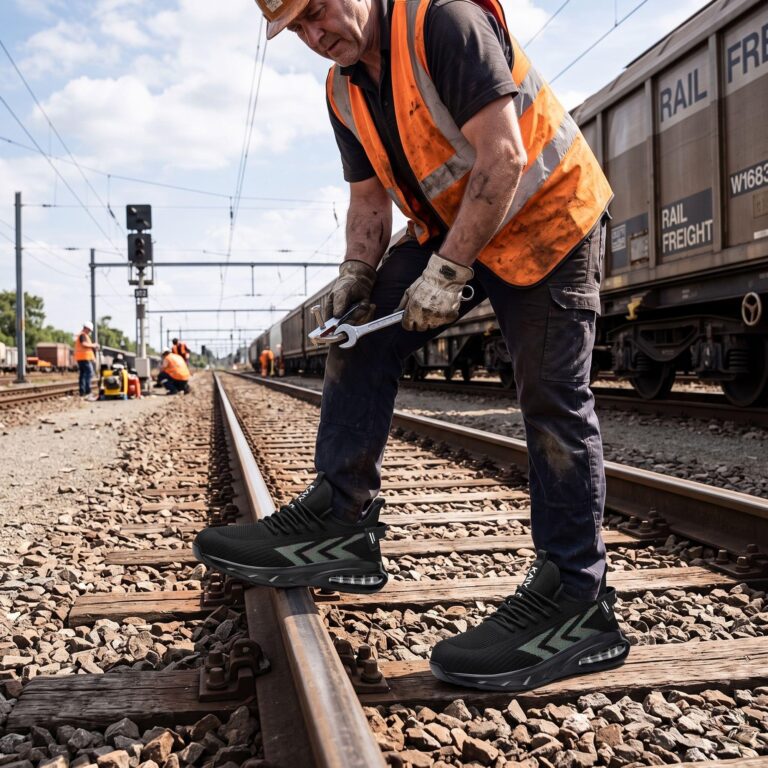


ESD Safety Shoes Testing Standards are essential for evaluating the electrical performance and electrostatic protection of safety footwear. ESD safety shoes must maintain controlled electrical resistance to prevent static charge accumulation in sensitive working environments. Understanding the applicable testing methods, resistance requirements, and international standards helps manufacturers and buyers verify product compliance and select suitable footwear for industrial applications.
Why Do ESD Safety Shoes Need Specialized Testing?
In electronics manufacturing, even a small electrostatic discharge can damage sensitive components. Some damage is immediately visible, while other defects may remain undetected until the finished product is used.
Workers can accumulate static electricity through walking, friction, and contact with different materials. When this charge is released, it may affect electronic circuits, semiconductor components, and precision instruments.
ESD safety shoes help control this risk by providing an electrical pathway between the human body and the grounded floor.
However, the electrical performance of footwear depends on several factors:
- Outsole conductivity: The outsole material affects how electrical charges pass through the shoe.
- Footwear construction: Different materials and bonding methods can influence overall resistance.
- Flooring conditions: The footwear must work with the floor to establish an effective grounding pathway.
- Environmental humidity: Changes in moisture levels can affect the electrical characteristics of certain materials.
- Product wear: Repeated use, contamination, and outsole deterioration may change resistance over time.
This explains why ESD footwear requires standardized testing rather than relying on material descriptions or visual inspection.
Which Standards Apply to ESD Safety Footwear?
Several standards are involved in evaluating ESD footwear. Manufacturers need to distinguish between footwear testing, general safety requirements, and complete electrostatic protection systems.
IEC 61340-4-3: Footwear Electrical Resistance Testing
IEC 61340-4-3 is an important reference for measuring the electrical resistance of footwear.
The standard establishes a laboratory test method that evaluates the resistance between the footwear and the test electrode arrangement.
The procedure considers factors such as:
- Sample preparation and conditioning.
- Electrode arrangement and contact.
- Applied electrical voltage.
- Environmental temperature and humidity.
- Resistance measurement and recording.
The results are expressed in ohms (Ω).
Manufacturers can use these measurements to evaluate whether a particular footwear design meets the electrical specifications established for its intended application.
It is important to understand that this standard describes how to perform the test. It does not establish one universal ESD pass/fail resistance limit for every workplace.
IEC 61340-4-5: Testing the Footwear-Flooring Combination
A shoe does not operate independently when it is used for personnel grounding.
The flooring material also affects the electrical pathway. Even footwear with suitable resistance may not provide the expected performance if the floor is incompatible.
IEC 61340-4-5 provides methods for evaluating electrostatic protection performance through the combination of a person, footwear, and flooring.
The assessment can include total electrical resistance and body voltage generated during walking.
This is particularly relevant to semiconductor factories, electronics assembly facilities, and other ESD-protected areas where workers move continuously between workstations.
IEC 61340-5-1: Requirements for ESD Control Programs
IEC 61340-5-1 addresses the establishment and implementation of an electrostatic discharge control program.
It covers more than footwear. Its requirements relate to personnel grounding, work surfaces, packaging, equipment, and other elements of an ESD-controlled environment.
Under IEC 61340-5-1:2024, a footwear-flooring system used for personnel grounding in standing operations must meet the applicable system resistance and body-voltage requirements.
These include:
- Total resistance to ground below \(1.0 \times 10^9\) Ω.
- Maximum body voltage generation below 100 V.
These values apply to the specified footwear-flooring-person system, not automatically to an individual pair of shoes tested separately.
EN ISO 20345:2022: General Safety Footwear Requirements
EN ISO 20345:2022 covers occupational safety footwear with protective toe caps and establishes requirements for mechanical and physical protection.
It also addresses antistatic properties.
Under the applicable antistatic requirement, electrical resistance is generally within 100 kΩ to 1,000 MΩ.
However, antistatic footwear and ESD footwear should not be treated as identical classifications. ESD applications may require additional testing and more specific electrical performance limits.
For manufacturers, meeting the general safety footwear requirements and demonstrating suitability for a particular ESD environment are two separate considerations.
ESD Safety Shoes Electrical Resistance Testing Process
A reliable ESD footwear test should follow a controlled procedure. Testing conditions, sample preparation, and measurement equipment can all influence the final results.
1. Prepare Representative Footwear Samples
Manufacturers should select finished footwear samples that represent the actual production model.
The test should not rely on outsole material samples alone because the electrical properties of the complete shoe may differ from those of an individual component.
IEC 61340-4-3:2017 specifies a minimum of three pairs for qualification testing.
Before measurement, samples must undergo the required cleaning, preconditioning, and environmental conditioning procedures. cdn.standards.iteh.ai+1
2. Control Temperature and Humidity
Environmental conditions are particularly important in electrical resistance testing.
IEC 61340-4-3:2017 specifies controlled conditioning procedures, including:
- Preconditioning at 40 ± 3°C and relative humidity below 15%.
- Conditioning at 23 ± 3°C and 12 ± 3% relative humidity.
- Electrical measurement under the specified controlled environment.
These conditions help reduce the influence of moisture and manufacturing-related material stresses on test results.
A laboratory report should identify the conditioning procedure rather than simply providing a resistance value. cdn.standards.iteh.ai+1
3. Perform the Resistance Measurement
After conditioning, the footwear is placed in the test arrangement specified by IEC 61340-4-3.
A resistance measuring instrument applies the specified test voltage and records the electrical resistance through the footwear.
The test evaluates the electrical pathway between the internal electrode and the external contact arrangement.
The recorded value allows manufacturers to compare the footwear against the resistance limits specified by the customer or applicable ESD control program.
A complete test record should include the sample identification, test conditions, applied voltage, measured resistance, and equipment information.
4. Conduct Footwear and Flooring System Evaluation
For workplaces that use footwear as the main personnel grounding method, individual shoe testing may not provide sufficient information.
A system evaluation should use the actual or representative ESD flooring and the specified footwear.
IEC 61340-4-5 includes two important assessment areas:
Electrical resistance measurement: Evaluates the resistance between the person and ground through the footwear and flooring.
Chargeability measurement: Uses a walking test to assess the voltage generated on the person’s body.
The results are specific to the footwear and flooring combination tested. They should not be presented as universal certification of the footwear model across all floor types. IEC+1
How Do Footwear Materials Affect ESD Testing Results?
Electrical resistance is closely related to material formulation and footwear construction. This is an important consideration during product development and mass production.
PU Outsole Formulation
Polyurethane is widely used in safety footwear because it offers flexibility, cushioning, and abrasion resistance.
For ESD applications, the electrical properties of the PU formulation must also be considered.
Conductive or dissipative additives may be incorporated into the formulation to achieve the required electrical characteristics.
However, adding conductive materials does not automatically produce a compliant finished shoe. The formulation, processing conditions, and final outsole structure all need to be evaluated.
Rubber Outsole Performance
Rubber compounds can also be developed for specific electrical resistance requirements.
Different formulations may produce different results, even when the outsole appearance and physical properties are similar.
Manufacturers should verify electrical resistance after the complete outsole manufacturing process.
Insole and Internal Construction
The electrical pathway may also be influenced by the insole and other internal components.
Changing the insole material, adding a removable footbed, or modifying the bonding structure can affect the electrical performance of the footwear.
This is especially important when customers request customized designs or additional comfort features.
For this reason, electrical testing should be repeated when significant construction or material changes are introduced.
Common Problems in ESD Safety Shoes Quality Control
Some footwear problems only become apparent after laboratory testing or actual workplace use.
| Common problem | Possible cause | Quality control measure |
|---|---|---|
| Excessive resistance | Unsuitable outsole formulation | Review material composition |
| Inconsistent test results | Material or production variation | Strengthen batch inspection |
| Resistance changes after wear | Outsole deterioration or contamination | Conduct periodic retesting |
| Different results on different floors | Flooring compatibility | Evaluate the complete system |
| Failed customized samples | Changes to internal materials | Retest the modified construction |
Manufacturers should pay particular attention to production consistency.
If only one sample from a batch is tested, variations between different production runs may go unnoticed. A suitable inspection plan should include representative sampling and additional testing when material suppliers, formulations, or production processes change.
What Should Overseas Buyers Request from an ESD Safety Shoes Manufacturer?
When sourcing ESD safety footwear, overseas buyers should look beyond product photographs and general compliance statements.
Technical documentation provides a clearer picture of the product’s actual electrical performance.
The following information is useful during supplier evaluation:
- Electrical resistance test reports.
- Applicable IEC testing methods and editions.
- EN ISO 20345 safety footwear test documentation.
- Outsole material specifications.
- Product construction details.
- Sample identification and production batch information.
- Footwear-flooring compatibility test results, when required.
Buyers should also confirm whether the product is intended for general antistatic applications or a specific ESD-protected working environment.
If the footwear is required for electronics manufacturing, the buyer should provide the workplace’s resistance limits and system testing requirements before production begins.
This allows the manufacturer to evaluate the outsole formulation, internal construction, and finished footwear against clearly defined specifications.
Final Considerations for ESD Safety Footwear Compliance
ESD safety shoes require more than a simple resistance measurement to demonstrate their suitability for industrial applications.
IEC 61340-4-3 establishes the method for measuring footwear electrical resistance, while IEC 61340-4-5 evaluates the performance of footwear and flooring together with a person. IEC 61340-5-1 provides broader requirements for electrostatic control programs. EN ISO 20345 addresses the general mechanical and physical safety requirements for occupational footwear.
Manufacturers should combine material selection, controlled production, laboratory testing, and batch quality inspection. Buyers should verify the applicable test methods and workplace acceptance criteria before placing bulk orders.
The distinction between footwear resistance and complete ESD system performance is particularly important. Correct testing helps manufacturers provide more reliable technical documentation and enables industrial customers to select footwear suited to their actual working conditions.
Written by Hong Gu Safety Shoes Technical Team, this content is compiled from practical production, long-term field applications, and rigorous testing results.
Shan Dong Hong Gu Shoes Industrial Co., Ltd. is a leading safety footwear manufacturer based in China, specializing in industrial foot protection with over 20 years of manufacturing expertise.
Products are fully certified under European standards (CE EN ISO 20345:2022), offering a full range of manufacturing processes including PU/PU Injection, PU/Rubber, Goodyear Welted, and Rubber Cemented constructions.