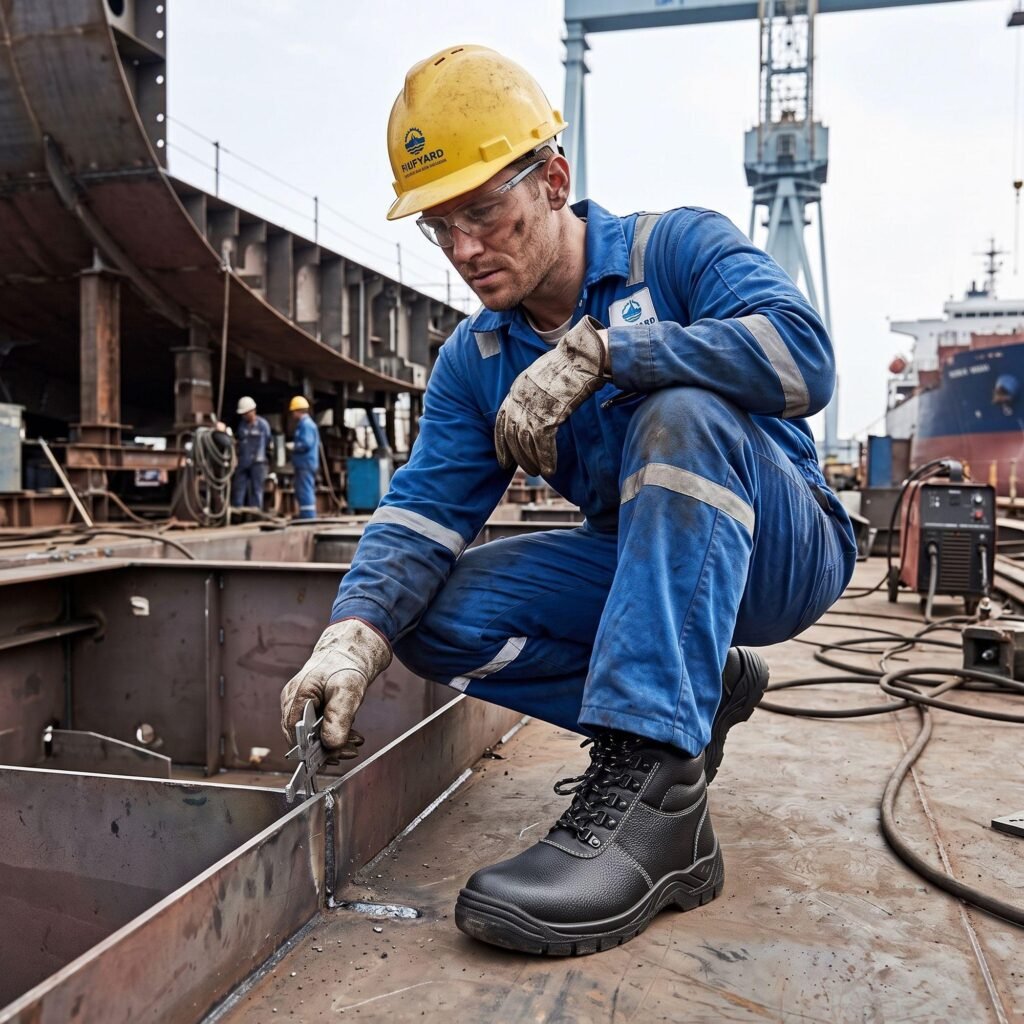
Workers who stand or walk for long hours often feel pressure in the heels, forefoot, and legs. The right cushioning system can reduce impact and improve comfort, but good anti-fatigue performance requires more than a soft insole.
Why Anti-Fatigue Safety Shoes Need Effective Cushioning
Industrial workers often spend eight or more hours on concrete floors, warehouse surfaces, production lines, or construction sites. These hard surfaces create repeated loading under the feet during walking and standing.
Safety shoes must provide protection against workplace hazards, but workers also need enough comfort for extended use. Poor cushioning can increase pressure around the heel and forefoot, especially when a worker walks frequently or stands in one position for a long period.
Anti-fatigue safety shoes use cushioning materials and structural designs to manage these repeated loads. The goal is not simply to make the shoe softer. A suitable design should balance shock absorption, pressure distribution, stability, durability, and protective performance.
The midsole, outsole, insole, heel area, and upper construction all contribute to the final wearing experience.
How Cushioning Technology Works in Safety Shoes
Shock Absorption
Every step creates an impact when the foot contacts the ground. The outsole and midsole receive this force and transfer part of it through the footwear structure.
Manufacturers commonly use materials such as EVA and polyurethane (PU) to create cushioning layers. These materials have different densities, resilience, compression characteristics, and durability.
EVA can provide lightweight cushioning and flexibility. PU can offer a useful balance between cushioning, durability, and resistance for industrial footwear. The actual performance depends on the material formulation, density, thickness, and construction method.
A suitable cushioning system should absorb repeated loading without losing its mechanical properties too quickly.
Pressure Distribution
Cushioning also affects how pressure moves across the foot.
When a worker stands on a hard surface, certain areas of the foot can carry more load than others. A properly designed footbed can support the heel and arch while helping distribute pressure across a larger contact area.
The insole and midsole should work together. A very soft insole cannot compensate for an unsuitable midsole structure. Manufacturers therefore need to consider the complete footwear system rather than focusing on one cushioning component.
Heel Cushioning
The heel receives considerable loading during walking. A dedicated heel-cushioning zone can help manage repeated impact.
Some safety shoe designs use a thicker cushioning section under the heel. Others combine materials with different densities to create a balance between impact absorption and stability.
However, excessive softness can create another problem. Workers need stable footing when they turn, climb stairs, carry loads, or move across uneven surfaces. For this reason, anti-fatigue safety shoes should combine cushioning with adequate support.
Outsole and Midsole Interaction
The outsole connects the shoe to the working surface, while the midsole often provides much of the cushioning effect.
PU, rubber, and other outsole materials can provide different levels of flexibility, abrasion resistance, grip, and durability. Manufacturers need to select the construction according to the intended working environment.
Slip resistance also matters. Under EN ISO 20345:2022, safety footwear must meet applicable requirements for protective performance, including requirements related to impact and compression protection and slip resistance.
Cushioning should therefore support the overall safety design rather than work as an isolated feature.
Choosing Anti-Fatigue Safety Shoes for Different Jobs
Different working environments require different cushioning characteristics.
Warehouse and Logistics Work
Warehouse workers often walk long distances during a shift. A lightweight shoe with responsive cushioning can reduce the physical burden of repeated movement.
The shoe should also provide sufficient outsole grip and durability because workers may move between different floor surfaces.
Factory and Production Work
Factory workers may spend several hours standing beside production equipment. In this situation, pressure distribution and heel support become particularly important.
A stable cushioning structure can help workers maintain a comfortable stance without making the sole excessively soft.
Construction and Heavy Industrial Work
Construction workers face more demanding conditions. Their safety shoes may need protection against impact, compression, puncture, slipping, and other hazards.
For these applications, cushioning must work together with protective components. A comfortable sole cannot replace the protective requirements of the footwear.
Wet or Challenging Environments
Workers who operate in wet areas or environments with oil and other substances need to consider outsole resistance and grip alongside cushioning.
Material selection should match the actual working conditions. Cushioning performance alone cannot determine whether a safety shoe suits a particular workplace.
Common Mistakes When Choosing Cushioning
Mistaking Softness for Comfort
A very soft shoe may feel comfortable during the first few minutes of wear, but softness does not automatically mean better long-term performance.
Excessive compression can reduce stability and change the way the foot interacts with the ground. Good cushioning should provide controlled support rather than simply maximize softness.
Looking Only at the Insole
The insole represents only one part of the cushioning system.
The midsole, outsole, heel structure, footbed, and shoe fit all influence comfort. Manufacturers should evaluate these components as a complete system.
Ignoring Durability
Cushioning materials experience repeated compression during daily use. Material fatigue can change the cushioning characteristics over time.
Manufacturers should therefore examine compression behavior, resilience, abrasion resistance, bonding strength, and other relevant properties during product development and quality control.
Treating Comfort as a Substitute for Safety
Comfort and protection serve different purposes.
A safety shoe should meet the requirements relevant to its intended application while also providing suitable cushioning and fit. Workers should select footwear according to workplace hazards rather than choosing a shoe based only on how soft it feels.
What Should Good Anti-Fatigue Safety Shoes Provide?
A well-designed pair of anti-fatigue safety shoes should balance several factors:
- Heel and forefoot cushioning
- Controlled shock absorption
- Effective pressure distribution
- Stable foot support
- Suitable flexibility
- Durable cushioning materials
- Appropriate outsole grip
- Required protective performance
- Correct fit and internal space
The ideal combination depends on the job. A warehouse worker who walks throughout the day may need a different cushioning structure from a construction worker who spends more time carrying heavy loads on uneven ground.
In simple terms, anti-fatigue safety shoes use cushioning, pressure distribution, support, and durable construction to improve comfort during prolonged standing and walking. EVA, PU, and other cushioning materials can help manage repeated impact, but the complete shoe structure determines how well the footwear performs in real working conditions.
Manufacturers should evaluate cushioning through material testing, structural testing, wear testing, and practical application feedback. This approach provides a more reliable basis for developing safety footwear than relying on softness alone.
Written by Hong Gu Safety Shoes Technical Team, this content is compiled from practical production, long-term field applications, and rigorous testing results.
Shan Dong Hong Gu Shoes Industrial Co., Ltd. is a leading safety footwear manufacturer based in China, specializing in industrial foot protection with over 20 years of manufacturing expertise.
Products are fully certified under European standards (CE EN ISO 20345:2022), offering a full range of manufacturing processes including PU/PU Injection, PU/Rubber, Goodyear Welted, and Rubber Cemented constructions.