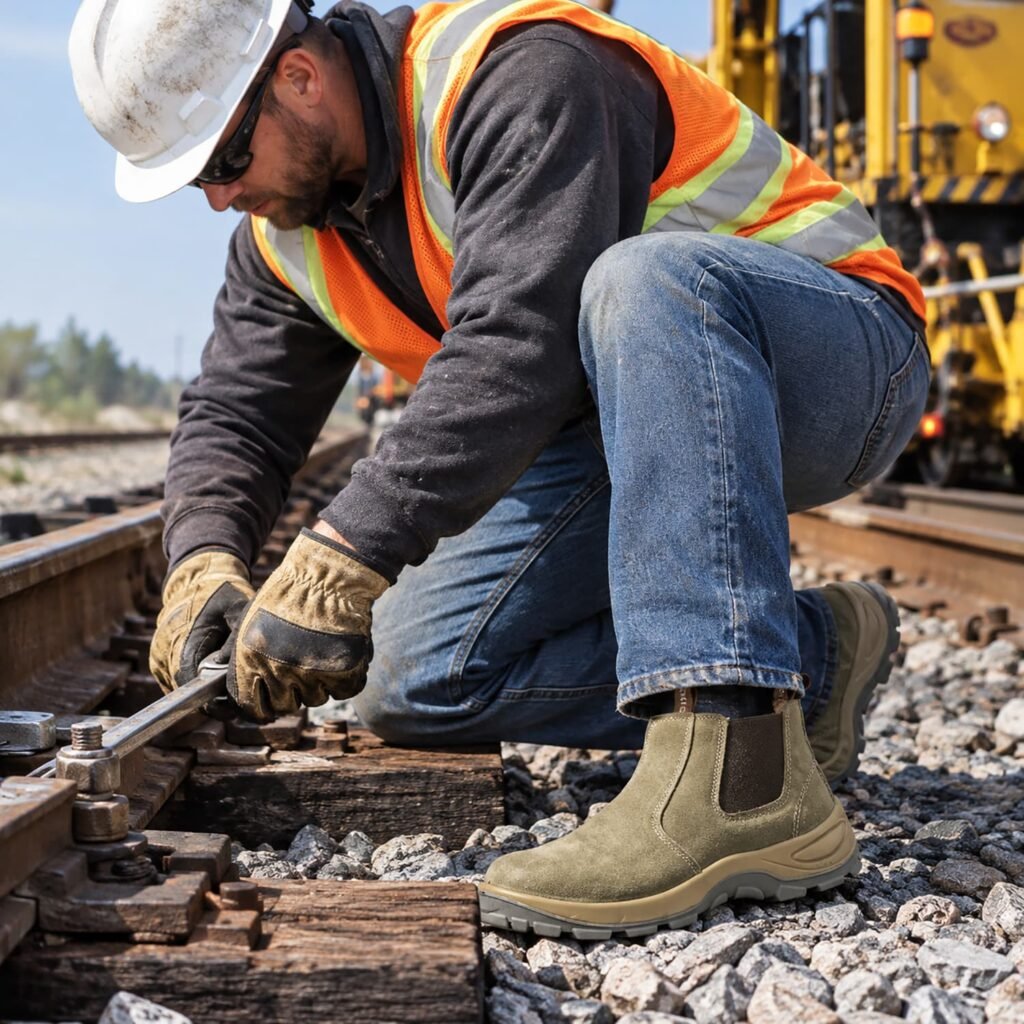
Automotive manufacturing workers face risks from falling components, sharp metal edges, slippery floors, and heavy equipment. Choosing the right safety shoes requires more than a protective toe cap. Footwear must match each workstation, floor condition, and exposure risk while remaining comfortable throughout long shifts.
What Foot Hazards Do Workers Face in Automotive Manufacturing Plants?
Automotive manufacturing involves several processes, including stamping, welding, machining, assembly, painting, and vehicle inspection. Each process creates different hazards, so one type of safety footwear may not suit every department.
Heavy components and falling objects: Workers handling engine parts, metal panels, tools, and mechanical assemblies need protective toe caps that meet the required impact and compression performance. Steel toe caps and composite toe caps are common options, but the appropriate choice depends on the applicable safety standard and workplace risk assessment.
Sharp metal fragments: Stamping, machining, and metal fabrication can expose workers to sharp debris. Where puncture hazards exist, safety shoes with suitable penetration-resistant midsoles can help protect the sole of the foot. The required protection should match the size, shape, and likely force of the penetrating objects.
Oil, coolant, and wet floors: Machining areas often contain lubricants and metalworking fluids. Assembly and maintenance zones may also have water, cleaning agents, or other contaminants on the floor. Outsoles should provide suitable slip resistance under the actual conditions. Oil-resistant rubber or polyurethane compounds may be appropriate, but oil resistance alone does not guarantee slip resistance.
Electrical hazards: Maintenance technicians and workers near electrical equipment may require footwear with specific electrical properties. Ordinary safety shoes should not be assumed to provide electrical insulation. Employers must select footwear according to the electrical risk assessment and applicable requirements.
Long periods of standing and walking: Assembly-line workers may spend most of a shift standing, walking between workstations, or repeatedly climbing in and out of vehicles. Poorly fitting footwear can contribute to foot fatigue, discomfort, and reduced mobility. Fit, cushioning, weight, and stability are therefore important selection factors.
How to Choose Safety Shoes for Automotive Manufacturing
The most effective approach is to match the footwear to the job rather than choosing a single model for the entire plant.
1. Select the Right Toe Protection
Protective toe caps are essential in areas where heavy parts or tools may fall onto workers’ feet. Steel toe caps offer strong impact protection and are widely used in industrial footwear. Composite toe caps can reduce footwear weight and do not conduct heat or cold as readily as steel, although their performance depends on the material and construction.
When comparing safety shoes, check the tested impact and compression ratings rather than relying on appearance or material alone. The toe protection must comply with the safety requirements applicable to the facility.
2. Choose Puncture Protection for Metalworking Areas
Workers in stamping, machining, and maintenance may encounter screws, metal chips, sharp offcuts, or other objects capable of penetrating the outsole.
A penetration-resistant midsole can reduce this risk. Depending on the design, the protective layer may be made from metal or non-metallic materials. Coverage, flexibility, and the type of penetration test matter when selecting footwear.
Not every automotive workstation requires the same puncture protection. A production area with sharp metal debris presents a different risk from a clean vehicle assembly line. Employers should evaluate the floor and work process before specifying this feature.
3. Match the Outsole to the Floor
Slip resistance is particularly important in automotive manufacturing because oil, coolant, dust, and cleaning residues can change the traction available underfoot.
Polyurethane (PU) outsoles are commonly used because they can provide cushioning and relatively low weight. Rubber outsoles are often selected for demanding environments where abrasion resistance and heat performance are important. Dual-density PU and PU/rubber constructions can combine different properties in one sole design.
However, no outsole material is automatically suitable for every factory floor. Performance depends on the compound, tread pattern, surface texture, contamination, and test conditions. Where possible, evaluate footwear against the actual flooring and contaminants found in the plant.
4. Consider ESD and Electrical Requirements Separately
Automotive plants may handle electronic control units, sensors, wiring systems, and other electrostatic-sensitive components. In designated electrostatic discharge (ESD) areas, workers may need footwear that forms part of a verified ESD control system.
ESD footwear is designed to help dissipate static electricity. It is not the same as electrically insulating footwear, and the two functions should not be confused.
Where electrical shock is a concern, the employer must identify the appropriate protective category and applicable testing requirements. A shoe marketed as antistatic or ESD-rated should never be treated as a substitute for electrical hazard protection without evidence that it meets the required specification.
5. Prioritize Fit and Comfort for Full Shifts
Comfort is a practical safety consideration in automotive manufacturing. Workers may wear safety shoes for eight hours or longer, often while performing repetitive movements.
Look for a secure heel fit, sufficient toe-box space, stable support, and cushioning suited to the task. Excessive pressure across the forefoot can cause discomfort, while an overly loose fit may reduce stability. Breathable linings and moisture-management features can also help workers remain comfortable during physically demanding shifts.
Footwear should be tried on with the socks normally worn at work. Employers should also consider different foot widths and sizes when procuring safety shoes for a large workforce.
Which Safety Footwear Standards Should Automotive Plants Check?
Safety footwear standards help purchasing teams compare products using defined performance requirements. The correct standard depends on the destination market, workplace hazards, and the employer’s PPE policy.
For facilities purchasing footwear for European markets, EN ISO 20345:2022 specifies basic and additional requirements for safety footwear, including mechanical protection, slip resistance, thermal properties, and ergonomic performance. The applicable amended edition and conformity requirements should also be checked when purchasing products for the European market.
Reference: https://www.iso.org/standard/73222.html
The following markings can help buyers identify relevant features:
- S1: Basic safety footwear requirements with features including a closed heel area, antistatic properties, and energy absorption in the heel.
- S2: Adds resistance to water penetration and absorption in the upper.
- S3: Includes additional sole penetration protection and other requirements specified by the applicable edition and classification.
- PS or PL: Identifies particular penetration-resistance options using non-metallic inserts, with different test nail dimensions.
- SR: Indicates additional slip-resistance performance under the specified test conditions.
- FO: Indicates resistance of the outsole to hydrocarbons.
These markings should be verified against the exact standard edition and the product’s conformity documentation. They do not mean that every shoe with the same classification will perform identically on an automotive factory floor.
Reference: https://www.uvex-safety.ie/en/knowledge/safety-standards/safety-footwear/guide-to-en-iso-203452022/
For plants operating in the United States, buyers should confirm compliance with the applicable workplace requirements and recognized protective footwear specifications. Requirements differ by jurisdiction, so European markings should not automatically be treated as proof of compliance with US requirements.
Common Mistakes When Purchasing Automotive Safety Shoes
Choosing footwear by price alone. A lower purchase price may not reflect service life, comfort, or suitability for the work environment. Procurement teams should compare protective features, construction quality, replacement frequency, and maintenance requirements.
Assuming all safety shoes are slip-resistant in every condition. Standardized slip tests provide useful evidence, but actual traction can change with the type and amount of contamination. Plants should consider the specific combination of flooring, oil, coolant, and cleaning products found at each workstation.
Using one specification across every department. Workers in a stamping area may need stronger protection against impact and sharp debris, while electronics assembly personnel may require verified ESD footwear. A job-based specification is more appropriate than a single plant-wide model.
Ignoring footwear inspection and replacement. Damaged uppers, worn tread, separated soles, exposed protective components, and compromised seams can affect performance. Workers should inspect their shoes regularly and follow the employer’s replacement procedures. Footwear exposed to chemicals, heat, or repeated mechanical stress may need replacement sooner than footwear used in cleaner conditions.
Treating certification as a substitute for risk assessment. Certification demonstrates that a product has met defined requirements under specified testing conditions. It does not eliminate workplace hazards or establish that a shoe is suitable for every task.
How Can Purchasing Teams Specify the Right Safety Shoes?
Before requesting quotations from a safety footwear manufacturer, purchasing teams should document the following information:
- Workstation and hazards: Identify falling parts, compression risks, sharp debris, oil, moisture, heat, and electrical or electrostatic exposure.
- Required protection: Specify toe protection, penetration resistance, slip resistance, and any additional features required by the risk assessment.
- Applicable standards: Identify the destination market and confirm the relevant standard, product classification, and conformity documents.
- Fit and working conditions: Define sizing requirements, shift duration, walking distance, temperature, and expected wear.
- Sample evaluation: Review product markings, documentation, construction, fit, and relevant test results before placing a bulk order.
- Quality consistency: Confirm that production footwear matches the approved sample and technical specification. For repeat orders, clarify inspection procedures and acceptable quality criteria.
These steps help procurement teams compare products on performance rather than relying on catalogue descriptions alone. They also make it easier to identify which features are necessary for each department and which would add cost without addressing a documented hazard.
What Are the Best Safety Shoes for Automotive Manufacturing Plants?
The best safety shoes for automotive manufacturing plants are those that match the hazards of the specific workstation while meeting the applicable safety footwear standard. Protective toe caps are important where heavy components may fall, penetration-resistant midsoles are useful where sharp debris is present, and tested slip-resistant outsoles are valuable on contaminated floors. ESD footwear should be selected for designated electrostatic-control areas, while electrical hazards require separate assessment and appropriate protective measures.
For long production shifts, fit, stability, cushioning, and durability also deserve attention. Employers should assess each work area, verify product documentation, and evaluate samples under realistic conditions before making a bulk purchase. This approach provides a clearer basis for selecting suitable industrial safety footwear than choosing a model solely by appearance, price, or a single certification marking.
Written by Hong Gu Safety Shoes Technical Team, this content is compiled from practical production, long-term field applications, and rigorous testing results.
Shan Dong Hong Gu Shoes Industrial Co., Ltd. is a leading safety footwear manufacturer based in China, specializing in industrial foot protection with over 20 years of manufacturing expertise.
Products are fully certified under European standards (CE EN ISO 20345:2022), offering a full range of manufacturing processes including PU/PU Injection, PU/Rubber, Goodyear Welted, and Rubber Cemented constructions.