

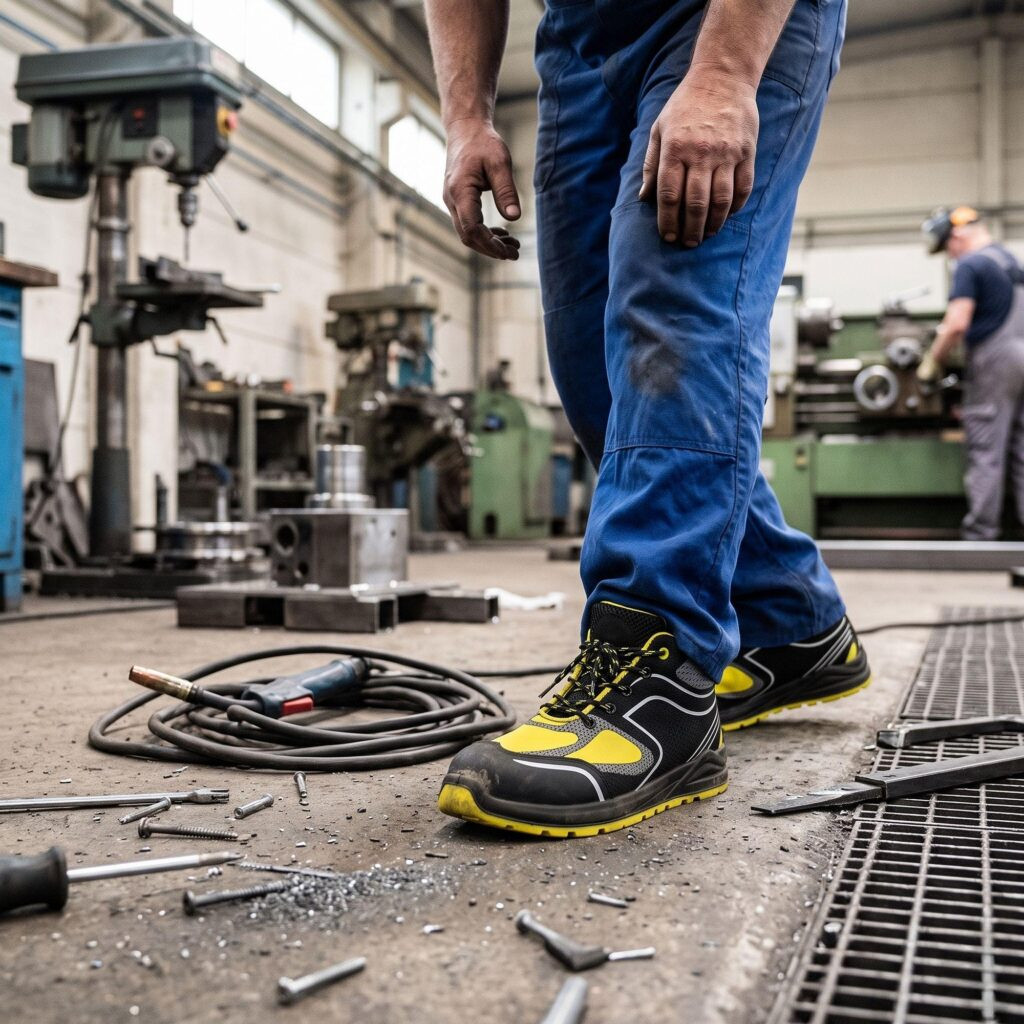
Choosing the right safety footwear standard can be difficult when a product targets different international markets. EN ISO 20345 and ASTM F2413 cover similar workplace risks, but they use different test methods, classifications, and marking systems. Understanding these differences helps buyers and manufacturers select the correct safety footwear for each market.
Why EN ISO 20345 and ASTM F2413 Are Often Compared
EN ISO 20345 and ASTM F2413 are widely used safety footwear standards, but they come from different technical and regulatory systems.
EN ISO 20345 covers general-purpose safety footwear and defines requirements for toe protection, mechanical risks, slip resistance, thermal risks, electrical properties, and other performance areas. The current international standard is ISO 20345:2021, with Amendment 1 published in 2024.
ASTM F2413-24 specifies performance requirements for protective toe cap footwear. It covers toe impact and compression as well as additional protection against risks such as punctures, metatarsal impact, electrical hazards, and static buildup.
Therefore, manufacturers should not treat the two standards as interchangeable. A safety shoe that meets EN ISO 20345 does not automatically meet ASTM F2413.
EN ISO 20345 vs ASTM F2413: Main Differences
| Requirement | EN ISO 20345 | ASTM F2413 |
|---|---|---|
| Main application | European and international markets | U.S. market |
| Current standard | ISO 20345:2021 + A1:2024 | ASTM F2413-24 |
| Toe impact | 200 J | Approximately 101.7 J |
| Toe compression | 15 kN | Approximately 11.1 kN |
| Toe protection | Required for safety footwear | Required for covered footwear |
| Puncture protection | Specific EN ISO classifications | PR classification |
| Electrical protection | EN ISO classifications | EH, SD, Cd |
| Slip resistance | Included within EN ISO requirements | Uses applicable ASTM test systems |
| Additional protection | CI, HI, HRO, LG, FO, SR and others | Mt, PR, EH, SD, Cd and others |
| Marking | EN ISO symbols and categories | ASTM identification and protection codes |
The numerical requirements also show an important difference. EN ISO 20345 uses a 200 J toe impact test and a 15 kN compression test. In comparison, ASTM F2413 uses approximately 101.7 J impact energy and 11.1 kN compression.
For this reason, buyers should check the exact standard listed on the test report instead of comparing only the product description.
How Toe Protection Requirements Differ
Toe protection forms a major part of both standards, but each system evaluates it in its own way.
Under EN ISO 20345, safety footwear must meet the applicable toe-cap requirements before it can receive the relevant safety classification. The standard then adds different requirements depending on the footwear category and protection level.
ASTM F2413-24 uses impact resistance (I) and compression resistance (C) to identify protective toe performance. The specification also covers additional classifications for specific workplace risks.
For example, ASTM footwear can include requirements for:
- Metatarsal protection
- Puncture resistance
- Electric hazard protection
- Static dissipative properties
- Conductive properties
As a result, two shoes may use similar steel or composite toe caps but still require different testing for different markets.
The toe-cap material alone does not determine compliance. Steel, aluminum, and non-metallic materials can all provide toe protection when the finished footwear meets the required test criteria.
Puncture Resistance Uses Different Test Systems
Puncture protection also requires careful comparison.
EN ISO 20345 defines penetration resistance through its own classifications and test methods. The footwear construction must meet the specified performance level for the applicable category.
Meanwhile, ASTM F2413 uses the PR classification for puncture-resistant footwear. ASTM F2412 provides the associated test methods for protective footwear, including puncture resistance.
In practice, manufacturers should not describe a product simply as having a “puncture-resistant sole.” The technical specification should identify the applicable standard and test method.
The protective layer also matters. Its material, thickness, position, and construction can all affect the final test result.
Electrical Protection Is Not the Same in Both Standards
Electrical protection often causes confusion because the two standards use different terms.
ASTM F2413 includes several electrical classifications:
- EH — Electric Hazard
- SD — Static Dissipative
- Cd — Conductive
These classifications address different workplace risks. For example, EH footwear targets electrical hazards, while SD footwear controls static buildup.
EN ISO 20345 uses a different classification system for electrical properties. Therefore, buyers should not directly convert an EN ISO electrical symbol into an ASTM classification.
For example, ESD-related footwear should not automatically receive an ASTM EH description. ESD control and electric shock protection serve different purposes.
Slip Resistance Requires Careful Specification
Slip resistance is another area where the two systems differ.
EN ISO 20345 includes slip resistance within its footwear performance requirements. The latest standard also introduced updated requirements and classifications for slip performance.
By contrast, ASTM uses its own test methods and specifications for footwear traction and slip performance.
Therefore, the phrase “slip-resistant safety shoe” does not provide enough technical information for an international order. Buyers should specify the required standard, test method, and performance level.
This approach also helps manufacturers select the correct outsole compound and construction method before production begins.
Common Mistakes When Comparing EN ISO 20345 and ASTM F2413
Mistake 1: Assuming One Certificate Covers Both Standards
A product tested under EN ISO 20345 does not automatically qualify under ASTM F2413.
Instead, manufacturers should identify the target market first and then arrange testing according to the required standard.
Mistake 2: Comparing Only the Toe Cap
A safety shoe contains many components that affect performance.
These include:
- Toe cap
- Upper material
- Insole
- Midsole
- Outsole
- Puncture-resistant layer
- Adhesive or injection system
- Overall footwear construction
Changing one of these components can affect the final test result.
For this reason, buyers should review the complete product specification rather than focusing only on the toe cap.
Mistake 3: Using One Test Report for Different Standards
A test report should clearly state the standard, test method, product model, and test results.
Before placing an international OEM order, buyers should check:
- The exact standard and revision.
- The tested footwear model.
- The toe-cap specification.
- The outsole and midsole construction.
- The required protection classifications.
- The laboratory test results.
- Whether the production sample matches the tested sample.
In addition, manufacturers should keep production specifications consistent with the tested footwear. Changes to the toe cap, outsole, materials, or construction method may require additional testing.
Which Standard Should You Choose?
The target market usually determines the appropriate standard.
For European markets, EN ISO 20345 is generally the relevant safety footwear standard. For the U.S. market, buyers commonly specify ASTM F2413 for protective toe footwear.
However, international projects may require both standards. In that situation, manufacturers should define the requirements before product development begins.
A practical specification should include the destination market, applicable standard, protection category, test requirements, footwear construction, labeling, and documentation.
This process reduces confusion during sampling and helps buyers compare products on the same technical basis.
Key Differences at a Glance
EN ISO 20345 and ASTM F2413 are separate safety footwear standards. EN ISO 20345:2021 uses a 200 J toe impact requirement and 15 kN compression requirement, while ASTM F2413-24 uses approximately 101.7 J impact energy and 11.1 kN compression. In addition, ASTM F2413 uses classifications such as I, C, Mt, PR, EH, SD, and Cd. Therefore, manufacturers and buyers should test and document safety footwear according to the exact standard required by the target market rather than treating EN ISO and ASTM compliance as equivalent.
Written by Hong Gu Safety Shoes Technical Team, this content is compiled from practical production, long-term field applications, and rigorous testing results.
Shan Dong Hong Gu Shoes Industrial Co., Ltd. is a leading safety footwear manufacturer based in China, specializing in industrial foot protection with over 20 years of manufacturing expertise.
Products are fully certified under European standards (CE EN ISO 20345:2022), offering a full range of manufacturing processes including PU/PU Injection, PU/Rubber, Goodyear Welted, and Rubber Cemented constructions.