
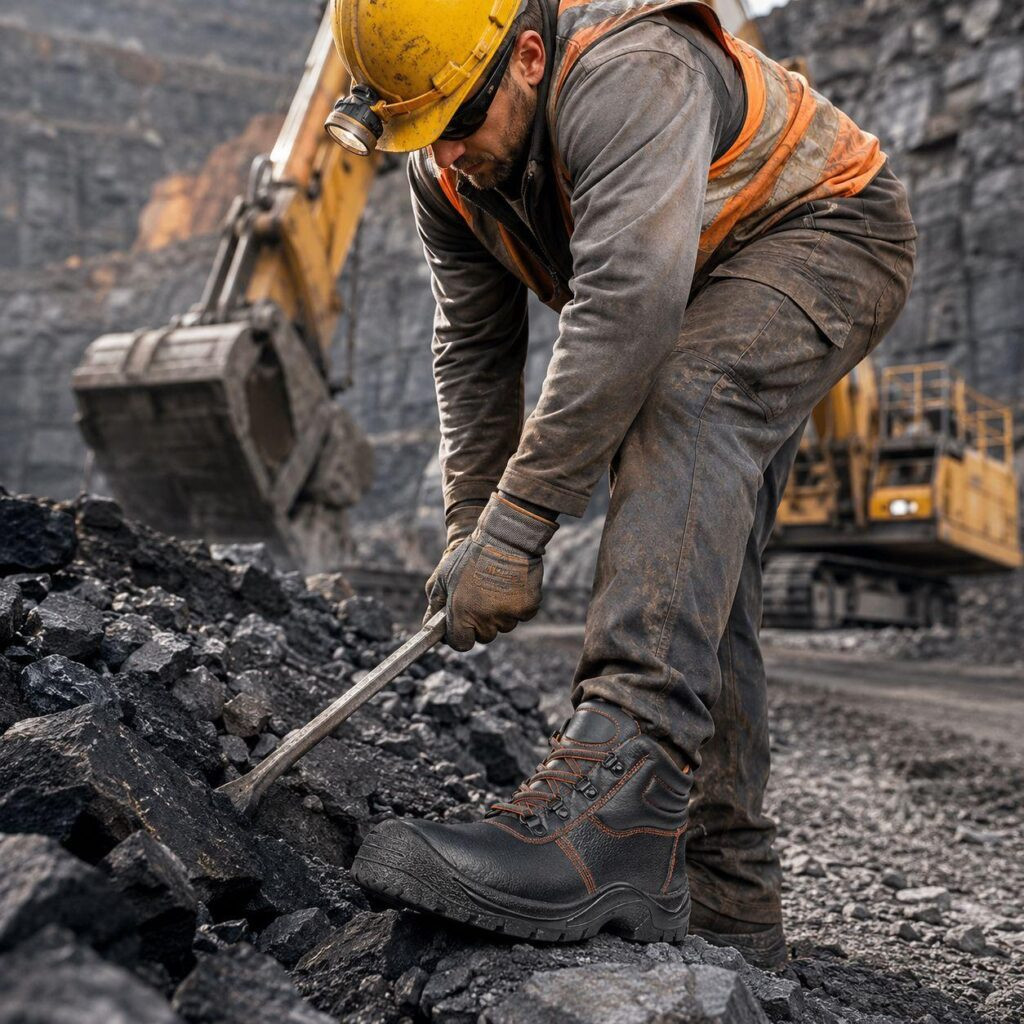
Safety shoes are often exposed to heavy loads, falling objects, and workplace pressure. Many buyers focus on the toe cap, but compression resistance is equally important. Understanding the test method and required force helps buyers select safety footwear for the right industrial environment.
Why Compression Resistance Matters in Safety Shoes
Compression resistance measures how well the protective toe area can withstand a heavy compressive force without allowing the internal clearance to fall below the required level.
This protection is particularly relevant in workplaces such as:
- Construction sites
- Warehouses and logistics facilities
- Manufacturing plants
- Mining operations
- Heavy equipment areas
- Engineering and maintenance workshops
A safety shoe can have a strong toe cap, but the complete shoe still needs to provide sufficient protection. The toe cap, upper, sole, lining, and internal construction all influence the final performance.
Under the European safety footwear standard EN ISO 20345:2022, protective footwear is tested against mechanical risks, including toe protection under compression and impact conditions.
Compression and impact are different tests. Impact simulates a heavy object striking the toe area. Compression applies a progressively increasing force to the toe area. These tests evaluate different types of workplace hazards.
How the Safety Shoe Compression Resistance Test Works
The compression resistance test is designed to determine whether the protective toe area can withstand a specified compressive load while maintaining adequate space for the foot.
A typical testing process includes several important stages.
1. Prepare the Test Specimen
The complete safety shoe is conditioned and prepared according to the applicable testing procedure.
The toe cap must be correctly positioned inside the shoe. The test specimen should represent normal production quality rather than a specially reinforced sample.
2. Position the Shoe Under Compression
The toe area is positioned between compression plates or other specified test equipment.
The loading direction and positioning are controlled because small differences in test setup can affect the result.
3. Apply the Required Force
The testing machine applies a gradually increasing compressive force to the protective toe area.
For safety footwear under EN ISO 20345:2022, the standard compression requirement for the protective toe area is generally expressed as a force of 15 ± 0.1 kN for the relevant test.
15 kN is approximately equivalent to 1,530 kgf under standard gravitational conversion.
The important point is that the test does not simply ask whether the toe cap can survive a large load. The remaining internal clearance is also evaluated.
4. Measure the Internal Clearance
After compression, the remaining space inside the toe area is measured using the specified test method and equipment.
The protective toe must maintain the required clearance. If the deformation reduces the available space below the applicable limit, the footwear does not meet the compression requirement.
This is why a visually strong steel or non-metallic toe cap does not automatically mean that the finished safety shoe passes the test.
5. Evaluate the Result
The laboratory evaluates both the applied force and the resulting deformation or clearance.
A compliant result means that the toe protection withstands the specified compression load while maintaining the required internal space.
| Test factor | What it evaluates |
|---|---|
| Compression force | Resistance to crushing loads |
| Toe cap deformation | Structural response to compression |
| Internal clearance | Remaining protection space |
| Test positioning | Accuracy and repeatability |
| Complete footwear construction | Overall protective performance |
Compression Resistance vs. Impact Resistance
These two tests are often confused.
Impact resistance evaluates the ability of the toe protection to withstand a sudden strike. The test involves a defined impact energy.
Compression resistance evaluates the ability of the toe protection to withstand a heavy load applied progressively.
For example, a falling object is closer to an impact scenario, while a heavy machine component pressing down on the toe is closer to a compression scenario.
Both risks can exist in industrial workplaces, so selecting the correct safety footwear classification is important.
Common Factors That Affect Compression Performance
Compression performance is not determined by the toe cap alone.
Toe Cap Material
Steel, aluminum, and non-metallic toe caps can have different mechanical properties. Their design, thickness, geometry, and manufacturing quality all affect deformation behavior.
Toe Cap Shape
A properly designed toe cap distributes force across the protective structure. Poor geometry can create concentrated stress and excessive deformation.
Shoe Last and Internal Volume
The shape of the shoe last affects the space available around the toe cap. Even when the toe cap itself performs well, insufficient internal volume can affect the final clearance measurement.
Upper Construction
The upper must hold the protective toe cap in the correct position. Poor assembly can cause movement or deformation during testing.
Sole and Strobel Construction
The sole does not directly replace the function of the toe cap, but the overall footwear structure affects stability and load distribution during testing.
Common Testing Mistakes and Misunderstandings
One common mistake is treating impact resistance and compression resistance as the same requirement. They represent different mechanical hazards and should be evaluated separately.
Another mistake is judging protection only by toe cap material. A steel toe cap is not automatically compliant simply because steel has high strength.
Testing only the toe cap is also insufficient when certification applies to complete footwear. Production assembly, positioning, internal clearance, and manufacturing consistency can influence the final result.
Buyers should also check the exact standard edition and certification documentation. Requirements can change between different editions of safety footwear standards.
For international procurement, it is useful to confirm:
- Applicable safety footwear standard
- Toe protection classification
- Compression test requirement
- Impact test requirement
- Test report or certification documentation
- Manufacturing consistency
- Applicable size range
- Intended workplace hazards
What Buyers Should Check Before Ordering Safety Shoes
For industrial procurement, compression resistance should be considered together with other protection requirements.
Depending on the working environment, additional properties may include:
- Slip resistance
- Puncture resistance
- Antistatic performance
- Electrical insulation
- Fuel oil resistance
- Heat resistance
- Water resistance
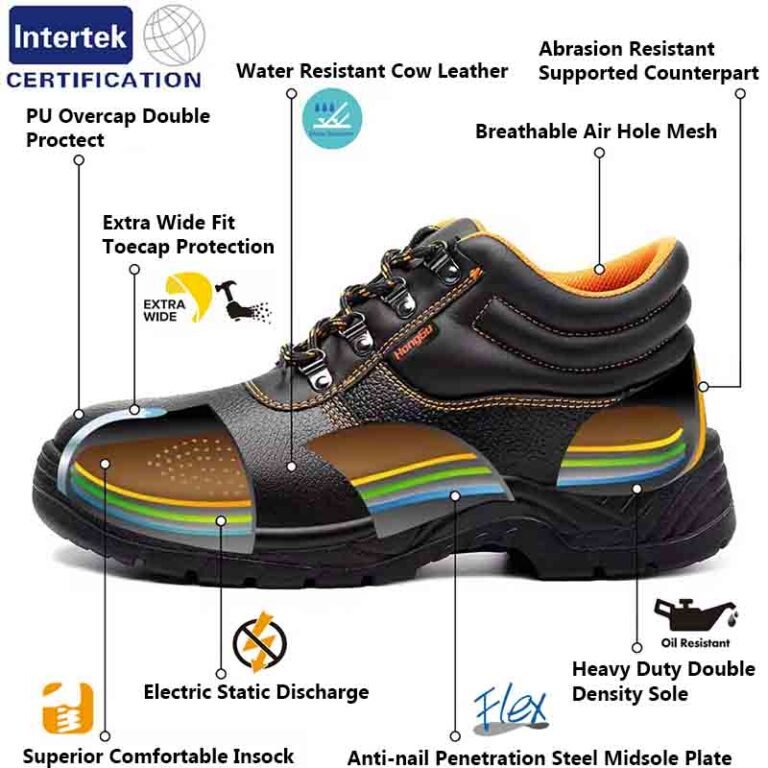
- Midsole protection
- Metatarsal protection
The correct specification depends on the actual workplace hazard.
A warehouse worker may have different requirements from a mining worker or construction worker. Choosing a safety shoe only because it has a steel toe may leave other workplace risks unaddressed.
Conclusion: What Is Safety Shoe Compression Resistance?
Safety shoe compression resistance is the ability of protective toe footwear to withstand a specified crushing force while maintaining the required internal clearance for toe protection. Under EN ISO 20345:2022, the relevant compression test uses a defined load and evaluates the deformation and remaining clearance of the protective toe area.
For buyers and distributors, the key point is simple: compression resistance is a performance characteristic of the complete safety footwear system, not merely a description of the toe cap material. Proper testing, manufacturing consistency, and compliance with the applicable standard are essential for reliable industrial foot protection.
Written by Hong Gu Safety Shoes Technical Team, this content is compiled from practical production, long-term field applications, and rigorous testing results.
Shan Dong Hong Gu Shoes Industrial Co., Ltd. is a leading safety footwear manufacturer based in China, specializing in industrial foot protection with over 20 years of manufacturing expertise.
Products are fully certified under European standards (CE EN ISO 20345:2022), offering a full range of manufacturing processes including PU/PU Injection, PU/Rubber, Goodyear Welted, and Rubber Cemented constructions.